After the Storm: Evan’s Rebuilding Season

image.png

The morning after Evan chose to stop running from himself felt strangely quiet. Not peaceful — not yet — but quiet in a way that made him aware of every breath. The world outside his window looked the same, but something inside him had shifted. The storm that had raged within him for years had finally broken, leaving behind a stillness he didn’t quite know how to inhabit.

He stood in his kitchen, hands wrapped around a mug of warm tea, staring at the sunlight stretching across the floor. It felt like the first morning in a long time that wasn’t blurred by escape. No drink from the night before. No smoke lingering in the air. No noise to drown out the ache. Just him — awake, present, and unsure.

But there was something honest about that uncertainty. Something clean.

Learning to Live in the Quiet

In the days that followed, Evan discovered that the hardest part of healing wasn’t the storm — it was the silence afterward. Without his old coping mechanisms, he felt everything more sharply. The loneliness. The fatigue. The memories he had pushed away.

But he also felt small things he had forgotten: the warmth of morning light, the sound of birds outside his window, the way his chest softened when he took a deep breath.

He realized that life had been offering him moments of beauty all along — he had just been too numb to notice.

Small Steps Toward Himself

Evan didn’t rebuild his life in sweeping gestures. He didn’t wake up one day transformed. Instead, he rebuilt himself through small, faithful acts that slowly stitched him back together.

He started taking short evening walks. At first, they were just a way to fill time, but soon he found comfort in the rhythm of his footsteps and the cool air on his face. He began cooking simple meals, discovering that the act of nourishing himself felt like a quiet apology to his own body.

One afternoon, he bought a few packets of seeds and planted them in the patch of soil behind his house. He didn’t know much about gardening, but something about placing those tiny seeds into the earth felt symbolic — a promise to himself that growth was still possible.

Every morning, he checked on them. Every morning, they reminded him that healing takes time.

Trusting Peace Again

As the weeks passed, Evan noticed something unexpected: the quiet no longer frightened him. It began to feel like a companion instead of a threat. He found himself sitting on the porch in the evenings, watching the sky change colors, feeling a kind of peace he hadn’t known in years.

He realized that peace wasn’t the absence of struggle — it was the presence of grounding. It was the ability to sit with himself without needing to escape. It was the slow rebuilding of trust between his mind and his heart.

Becoming Someone New

One morning, Evan stepped outside and saw the first green sprout pushing through the soil. It was small, fragile, almost unnoticeable — but it was alive. It had survived the dark, the cold, the uncertainty.

He knelt beside it, touched the soft leaf with the tip of his finger, and felt something inside him shift.

He wasn’t returning to who he used to be. He was becoming someone new — someone steadier, someone present, someone willing to feel.

The storm had shaped him, but the rebuilding was making him whole.
Posted in Uncategorized | 1 Comment

The Rebuilding Season

image.png

There comes a moment, after the chaos settles, when a person looks around and realizes the storm has finally passed. The noise is gone. The urgency is gone. And what remains is a stillness that feels both unfamiliar and strangely hopeful.

This is the rebuilding season — the quiet chapter that follows the decision to stop running, stop numbing, and start living with honesty. It’s not dramatic. It doesn’t announce itself. It arrives softly, like morning light slipping through a window, inviting us to begin again.

The Space Between What Was and What Will Be

Healing rarely begins with clarity. It begins with space — the space left behind when old habits fall away. For many, that space feels uncomfortable at first. It can feel empty, uncertain, even lonely.

But emptiness is not a void. It is a clearing. A place where new things can grow.

In this in‑between place, a person learns to breathe again. They learn to sit with themselves without reaching for the familiar escapes that once softened the edges of life. It is here, in this quiet pause, that the heart begins to whisper what it needs.

The Small Acts That Restore Us

Rebuilding doesn’t happen through grand declarations or sweeping changes. It happens through small, faithful acts that slowly stitch a life back together.

A walk at sunrise. A meal cooked with intention. A conversation that feels honest and safe. A moment of laughter that surprises the heart.

These small acts become anchors — reminders that healing is not a single event but a series of gentle choices.

Evan, for example, began tending a small garden behind his home. At first, it was just something to do with his hands, a way to fill the quiet. But as days passed, he noticed how the soil responded to care, how fragile seedlings pushed through the earth with quiet determination.

He realized he was doing the same.

Learning to Trust Peace

After years of chaos, peace can feel suspicious. Stillness can feel like a trap. Many people don’t trust calm because they’ve lived so long in survival mode that quiet feels unnatural.

But the rebuilding season teaches a different truth: Peace is not the absence of struggle — it is the presence of grounding.

Slowly, a person learns to trust the quiet again. They learn that stillness isn’t emptiness; it’s restoration. They learn that calm doesn’t mean something is about to go wrong — it means something is finally going right.

The Beauty of Slow Growth

Growth in this season is subtle. It doesn’t shout. It doesn’t rush. It unfolds the way spring returns after winter — quietly, steadily, with a patience that feels almost sacred.

A person wakes up one morning and realizes they feel lighter. They laugh without forcing it. They breathe without bracing. They look at their lives and see possibilities rather than pressure.

This is the beauty of slow growth: it transforms us without demanding that we notice every step.

Becoming Whole Again

Rebuilding is not about returning to who we were before the storm. It is about becoming who we were meant to be after it.

It is the season where strength is rebuilt, trust is restored, and the heart learns to open again. It is where we discover that life, even after loss or struggle, still holds beauty — and that every breath forward is an act of grace.

In the rebuilding season, we learn that healing is not loud. It is steady. It is faithful. And it is ours.

Posted in Uncategorized | Tagged , , , , | 1 Comment

Evan’s Escape

image.png

His story

Evan had mastered the art of pretending he was fine. When the world pressed too hard, he found comfort in small escapes — a drink after work, a cigarette on the porch, music turned up just loud enough to drown out his thoughts.

Each habit gave him a moment of peace, a pocket of silence where the world stopped spinning. But when the quiet faded, the same heaviness returned, stronger than before. He began to realize that the escape was costing him something — his clarity, his energy, his sense of self.

Coping mechanisms had become his shelter, but they were built on sand. They kept him safe from feeling, but they also kept him from healing.

The Turning Point

One evening, sitting alone with an untouched glass beside him, Evan watched the sunset through the window. The light spilled across the floor, soft and golden, and for the first time in a long while, he didn’t reach for anything. He just sat there.

He felt the ache in his chest, the tension in his shoulders, the swirl of thoughts he’d been avoiding. It wasn’t pleasant, but it was real. And in that reality, something shifted.

That night marked a quiet turning point. Evan began to walk instead of drink, to breathe instead of smoke, to talk instead of hide. He learned that facing life didn’t mean liking every part of it — it meant meeting it honestly.

Living on Life’s Terms

Over time, Evan discovered that living on life’s terms wasn’t about endurance; it was about presence. It was about learning to stand in the storm without running for cover, trusting that it would pass.

He still had hard days, but they no longer owned him. He found that peace wasn’t in the escape — it was in the staying.

Living on life’s terms meant accepting that joy and sorrow coexist, that growth often begins in discomfort, and that healing requires truth. It meant realizing that the heart is stronger than fear, and that courage isn’t loud — it’s steady.

Reflection: The Choice We All Face

Every person meets this crossroads at some point — the choice between escaping and engaging, between numbing and feeling. Coping mechanisms offer temporary comfort, but they keep us from the deeper peace that comes with acceptance.

When we stop running and start living, we discover that life, even in its hardest moments, has something to teach us. And in that learning, we find ourselves — whole, present, and beautifully human.

Posted in Uncategorized | Tagged , , , , , , | 1 Comment

Why We Reach for Coping Mechanisms — And What It Means to Live on Life’s Terms

image.png

The Weight People Carry

Everywhere you turn, you hear someone say, “Life is too much,” or “I need something to take the edge off.” People whisper it in grocery store lines, confess it to friends, or admit it quietly to themselves at the end of a long day. Life can feel heavy, unpredictable, and demanding. And when the weight becomes too much to hold, many reach for something — anything — that promises a moment of relief.

But beneath that reach lies a deeper story about how we handle discomfort, how we face ourselves, and how we learn to live with life exactly as it is.

The Human Need for Relief

Coping mechanisms often begin as small attempts to soothe overwhelming emotions. A cigarette to calm the nerves. A drink to soften the edges of a stressful day. A pill to quiet the mind. These choices don’t start as self-destruction; they start as self‑protection.

For a moment, the world feels quieter. The pressure lifts. The mind loosens its grip. But the relief is temporary — a pause button, not a solution.

People turn to these habits because they offer something immediate: a sense of control when everything feels uncontrollable. A moment of peace when the heart is tired of fighting. A way to escape feelings that feel too big to face.

Avoidance and the Art of Not Feeling

Coping mechanisms are often less about pleasure and more about avoidance. They create a buffer between a person and their own emotions. Instead of sitting with sadness, fear, or uncertainty, people step away from it.

Avoidance feels easier at the moment. It feels safer. But it also keeps life at a distance.

Living on life’s terms, however, asks something different. It asks us to stay present — even when it’s uncomfortable. It asks us to feel what we feel without numbing it, denying it, or running from it. This is not easy work. It requires courage, patience, and a willingness to be honest with ourselves.

The Psychology Behind the Escape

The brain is wired to seek relief. When someone uses a substance or distraction to escape stress, the brain rewards that behavior with a burst of comfort. Over time, the brain learns: This is how we survive.

But the real issue is rarely the cigarette, the drink, or the drug. The real issue is the pain underneath — the loneliness, the fear, the unresolved grief, the pressure to be strong when everything inside feels fragile.

People don’t reach for coping mechanisms because they are weak. They reach for them because they are hurting.

The Courage to Feel

Facing life directly is not about being tough. It’s about being honest. It’s about learning to sit with discomfort long enough to understand it. When someone chooses to feel instead of flee, something powerful happens.

They discover that emotions, even the painful ones, are survivable. They learn that feelings pass, that storms settle, that clarity comes. They begin to trust themselves again.

This is the quiet courage that transforms a life — the courage to stay present, even when it’s hard.

Living on Life’s Terms

Living on life’s terms doesn’t mean pretending everything is fine. It doesn’t mean smiling through pain or denying struggle. It means accepting that life is a mixture of joy and sorrow, ease and difficulty, clarity and confusion.

It means understanding that peace doesn’t come from escape — it comes from presence. It comes from learning to breathe through the hard moments instead of running from them. It comes from choosing growth over avoidance, even when the path feels steep.

The Path Toward Wholeness

There is a quiet strength that rises when a person stops running from life and begins walking with it. They learn healthier ways to cope — by talking, reflecting, creating, connecting, moving their bodies, and resting their minds.

They discover that life becomes more manageable when they stop trying to numb it and start trying to understand it.

And slowly, gently, they realize something important: They never needed the escape. They needed themselves — present, honest, and willing to feel

Posted in Uncategorized | Tagged , , , , , , , , | Leave a comment

Billy’s Quiet World

Billy discovers laughter

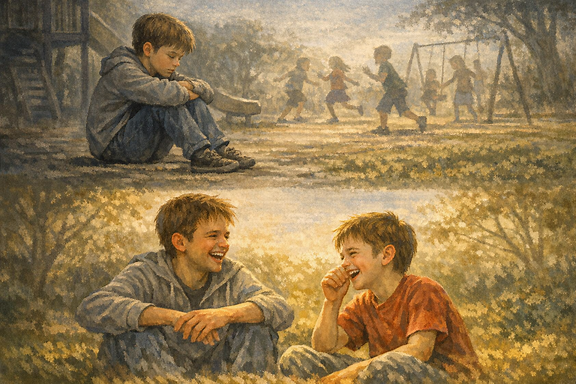
Billy was the kind of boy who moved through life quietly. He kept his eyes lowered, his shoulders slightly hunched, as if he were trying to take up as little space as possible. At school, he rarely smiled. His classmates laughed at jokes, shared stories, and played loudly on the playground, but Billy stayed on the edges, watching with a distant expression.

It wasn’t that he didn’t want to join in. He simply didn’t know how. Laughter felt like something that belonged to other people — something bright and effortless that never quite reached him.

The Unexpected Visitor

One afternoon, a new student named Jordan joined Billy’s class. Jordan had a way of carrying joy with him, as if it followed him like sunlight. He laughed easily — not the loud, attention-seeking kind, but the warm, genuine kind that made people feel lighter just by hearing it.

Jordan noticed Billy sitting alone during recess, quietly tracing shapes in the dirt with a stick. Instead of walking past, he sat down beside him.

“What are you drawing?” Jordan asked, his voice bright.

Billy shrugged. “Nothing.”

Jordan grinned. “Well, it’s the best ‘nothing’ I’ve ever seen.”

Billy looked up, confused — and Jordan burst into a soft laugh, the kind that invited rather than pushed. Something about it loosened the tightness in Billy’s chest. He didn’t laugh, not yet, but he felt something shift.

The Gift of Laughter

Over the next few days, Jordan kept showing up — not forcing conversation, not demanding anything, just bringing his easy humor with him. He told silly stories about his dog, exaggerated tales about his little brother, and playful observations about the world around them.

One day, Jordan described trying to teach his dog to fetch a shoe, but was chased around the yard by a very determined puppy who refused to give it back. He acted out the scene with dramatic flair, arms flailing, eyes wide.

Billy tried to hold it in, but the laugh escaped — small at first, then fuller, then unstoppable. It surprised him so much that he covered his mouth, as if he had done something wrong.

Jordan just smiled. “There it is,” he said softly. “I knew you had a great laugh.”

Posted in Uncategorized | Tagged , , | 3 Comments

The Lightness We Forget We Need

There are moments in life when laughter arrives like sunlight — unexpected, bright, and instantly warming everything it touches. It slips into the cracks of a heavy day, softens the edges of worry, and reminds us that joy is still alive inside us. Laughter doesn’t ask for permission; it simply rises, light and effortless, inviting us to breathe a little easier. In a world that often feels serious and demanding, laughter becomes a gentle companion, guiding us back to a sense of ease, connection, and simple human delight.

The Nature of Laughter

Laughter is one of the most universal human expressions. It crosses cultures, languages, and backgrounds, appearing in moments of joy, surprise, connection, and even relief. At its core, laughter is a release — a spontaneous response that signals ease, openness, and emotional freedom. It reminds us that even in a complicated world, there are moments where the heart simply lifts.

Laughter as Emotional Medicine

Laughter has long been recognized as a natural healer. It softens stress, loosens tension, and brings the mind back into balance. When we laugh, our bodies release endorphins — chemicals that elevate mood and reduce pain. It becomes a gentle reset, a way of telling the nervous system, “You are safe.” Even a brief moment of genuine laughter can shift the emotional atmosphere of an entire day.

The Balance Between Joy and Sorrow

Laughter does not erase life’s difficulties, nor does it deny them. Sometimes laughter and sorrow sit side by side, each revealing something about the human experience. There are moments when laughter is light and effortless, and others when it carries the weight of everything we’ve endured. But even then, it remains a reminder that joy is still possible — that the heart has not closed.

Laughter as Connection

Shared laughter creates instant connection. It dissolves tension, bridges differences, and brings people into harmony without effort. A room filled with laughter feels lighter, more open, more human. In relationships, laughter becomes a language of its own — a way of saying, “I see you,” “I feel safe with you,” or simply, “We’re in this together.” It strengthens bonds in ways words alone cannot.

A Narrative of Renewal Through Laughter

Imagine a woman who has carried months of quiet heaviness. Responsibilities, losses, and unspoken worries have settled into her shoulders. One afternoon, she visits a friend who tells a simple, unexpected story — something small, something ordinary, but told with warmth. Without planning to, she laughs. It rises out of her like a breath she didn’t know she was holding.

For a moment, everything inside her shifts. The weight doesn’t disappear; it just loosens. She feels lighter, clearer, more present. That single laugh becomes a reminder that joy still lives within her, waiting to be awakened. It doesn’t solve everything, but it opens a door — a door back to herself.

The Gift of Laughter

Laughter is not trivial. It is a quiet form of resilience, a way the body and spirit work together to restore balance. It heals, connects, and renews. It reminds us that even in the midst of life’s challenges, there is still room for joy, lightness, and moments that lift us beyond our worries.

Laughter is a gift — one that keeps us human, grounded, and beautifully alive.

*Spread the gift of laughter today and brighten someone’s day!

Posted in Uncategorized | Tagged , , , , , | Leave a comment

What Gives Me Direction in Life?


The Early Years: Morals Without Direction

To understand what provides direction in life, I must revisit my early childhood. I was raised with a strong foundation of morals and values. However, during those formative years and well into my thirties, I was emotionally, mentally, and spiritually lost. Therefore, I cannot attribute any particular guidance to my upbringing, aside from the moral compass instilled in me, which merely served as a rudimentary sense of right and wrong. I was essentially an emotional wanderer seeking direction.

The Inner Compass Awakens

My experiences include exploring various places, such as churches and groups. Invariably, an inner voice sensed that these influences were not for me; they did not resonate with my innate being. I believe an internal guidance system exists—one that provides direction and leads. It recognizes what feels familiar or opposed, and whether it is preferable to stay or to withdraw. This internal compass helped me discern whom I enjoy being around and whom I do not.

Experience as a Teacher

Nevertheless, even with moral principles and an inner sense of preference, a sense of direction remains elusive and is actively sought—specifically, a direction that fosters fulfillment, akin to following a map to a destination. Once this destination is attained, a sense of completeness ensues, and the journey concludes. I posit that experience functions as a guiding compass. As I gain lessons from my experiences, I learn to apply my inner understanding to them. This, in turn, enhances my sense of self, and both experience and learned lessons direct my path—propelling me forward in continual growth and learning until I reach a state of fulfillment.

The Question of Innate Morality

The question arises: if innate morals and values were never imparted to me, what principles would I then apply to life situations, experiences, and lessons? Would I possess an innate sense of morality—an internal awareness of what is right or wrong? Based on my internal sense of where I belong and where I feel uncomfortable, I would affirm that I do. It functions similarly to intuition or a third eye—an awareness that perceives what is needed and repels what is undesirable.

Discovering Scripture and the Teachings of Jesus

When I first encountered the Bible and began reading it, I felt an immediate connection to the stories. It felt like home because I finally found something my inner being could relate to. I found the stories and principles believable, and they fostered a sense of belonging and understanding within me. The nature of my innermost being found solace in these stories and principles. Specifically, learning about Jesus and the principles His teachings embody became a path my inner self automatically recognized and adhered to; it was an automatic consideration—a route back to my “home,” a pathway toward fulfillment and a sense of being found.

A Transformation of the Inner Life

My soul surrendered to the profound truth conveyed through these stories and principles without external coercion. They became the foundation of my inner being’s essence—food for my spiritual hunger and guidance for my seeking. It was a liberation—an anchoring that provided everything necessary for my inner life.

While my early moral and value systems, inherited from my parents, served as initial anchors, they did not nourish my soul or save me from internal struggles. They were not sufficient to prevent feelings of being lost or to provide navigation within my inner realm. However, the teachings of Jesus and the map they outlined transformed my understanding profoundly. Unlike my early morals, which instructed outward conduct, His teachings offered a way to inner peace—a refuge for my soul that provided guidance, solace, and freedom unlike anything I had encountered.

The Holy Spirit and the Creator as My Guiding Source

These teachings introduced me to the Holy Spirit and how to connect directly with a supreme source—what I call the Creator of the Universe. Consequently, the guiding path of my life is rooted in the stories and principles of the Bible and the teachings of Jesus. This is not practiced in a strictly religious sense but rather as a spiritual discovery—an inner journey toward a liberated and fulfilled self. It is a way of becoming rather than merely practicing, ultimately leading to liberation from the many afflictions that plague the soul.

The True Direction of My Life

This inner compass guides me, independent of external influences, teaching me to be true to myself regardless of worldly circumstances. I traverse the world grounded in this internal guidance, which supports and shapes my existence; it is the foundation and the true direction of my life.

Posted in Uncategorized | Tagged , , , , , | 2 Comments

The Quote That Never Leaves Me

“Being and Becoming” is always at the forefront of my mind. I feel every aspect of my journey of “becoming and being” deep within my soul, heart, emotions, mental state, and spirit. This focus is always present; it always has been. It accompanies me wherever I go, in every moment of my life, including my sleep.

It serves as a constant reminder of life and of who I was, who I am, and who I am becoming. I think about it all the time in my “being” because it is integral to my life. It will remain with me until I am no longer here, or until I arrive at a point in my “becoming and being” where I have no past, no present, no future. I just am.

It’s the quote that never leaves me!

Posted in Uncategorized | Tagged , , , | 3 Comments

What Defines a Good Friend?

A good friend is one of life’s quiet miracles — not loud, not demanding, not wrapped in performance, but revealed slowly through consistency, truthfulness, and care. Friendship is less about the excitement of connection and more about the steady presence of someone who chooses you again and again, not out of need or convenience, but out of genuine regard for your well‑being.

A true friend is safe. Safe to speak with, safe to be yourself around, safe to grow beside. They don’t weaponize your vulnerabilities or keep a ledger of your mistakes. Instead, they hold your truth with dignity. They listen to understand, not to judge or to gather ammunition. In their presence, you don’t shrink — you expand.

A good friend is also honest, but not harsh. They tell you the truth in a way that protects your spirit rather than bruises it. They don’t flatter you to gain favor, nor do they hide their real thoughts to avoid discomfort. Their honesty is rooted in love, not ego. They want to see you whole, not wounded.

And then there is loyalty — not blind loyalty, but the kind that stands with you in clarity. A loyal friend doesn’t disappear when life becomes complicated. They don’t retreat when you’re no longer convenient. They stay present, even when the season shifts, even when you’re not at your best. Their loyalty is not based on what you can offer, but on who you are.

A good friend also celebrates your growth. They don’t feel threatened when you evolve. They don’t cling to outdated versions of you. Instead, they encourage your transformation, even when it means you outgrow old patterns or old pain. They want you to rise, not remain.

There is also a quiet reciprocity in real friendship. Not a perfect balance, but a natural rhythm of giving and receiving. Both people pour in. Both people show up. Both people care. When one is weak, the other strengthens. When one is joyful, the other rejoices. When one is lost, the other helps them find their way back to themselves.

And perhaps most importantly, a good friend is consistent. Not perfect, not flawless, but steady. Their character doesn’t shift with their mood. Their affection doesn’t evaporate when challenged. Their presence doesn’t depend on applause. They are the same person in private as they are in public — reliable, grounded, and sincere.

Friendship, at its highest form, is a sanctuary. It is where truth is spoken gently, where love is expressed freely, and where two souls agree — without contracts or conditions — to walk together with respect, kindness, and mutual upliftment. It is one of the rare relationships in life that is chosen, not assigned, and sustained not by obligation, but by the quiet, daily decision to care.

A good friend doesn’t just make life easier. They make life richer, deeper, and more meaningful. They remind you of who you are, who you’re becoming, and who you were always meant to be.

What qualities do you assign to a good friend?

Posted in Uncategorized | Tagged , , , , , , | 13 Comments

What Law Does Love Fulfill?

There is a statement in scripture that is so simple we often glide past it without noticing its depth. Scripture states that “love is the fulfillment of the law.” For many, this sounds like a moral reminder — a gentle nudge to be kinder, softer, more patient. But beneath the surface lies something far more profound.

Esoterically, “the law” is not a list of commandments. It is not a set of rules to obey or a moral checklist to complete. In the inner life of the soul, the law is the Divine Pattern — the cosmic blueprint of harmony woven into creation itself. It is the way things are when they are aligned with God. It is the rhythm of the universe when nothing is out of tune.

When scripture says that love fulfills the law, it is not talking about behavior. It is talking about alignment.

The Law as the Blueprint of Harmony

Every created thing carries an inner design — a spiritual architecture that reflects the mind of God. Trees grow upward toward light. Rivers flow toward the sea. Stars move in precise, ancient paths. Even the human soul has a pattern: it was shaped to reflect the nature of the One who breathed life into it.

This is the Divine Pattern.

It is the quiet order beneath chaos. The harmony beneath noise. The truth beneath illusion.

When we live out of fear, ego, or separation, we fall out of alignment with this pattern. The soul becomes dissonant, like an instrument slightly out of tune. But when we love — truly love — something remarkable happens. The soul begins to resonate again with God’s frequency.

Love restores the original design.

Love as the Soul’s True Shape

Before life wounded us, before fear taught us to protect ourselves, before pride taught us to perform, before disappointment taught us to withdraw — the soul was created in the image of God. And God is love.

This means love is not something we add to ourselves. Love is what remains when everything false falls away.

When we love, we are not obeying a command. We are returning to our true shape. We are remembering who we were before the world told us who to be. We are stepping back into the Divine Pattern that has always been waiting for us.

This is why love fulfills the law: It restores the soul to its original alignment.

Love as the Dissolver of Separation

Esoterically, “sin” is not primarily wrongdoing. It is separation — the illusion that we are cut off from God, from others, and even from our own deepest self. Separation is the root of fear, conflict, and spiritual distortion.

Love dissolves separation.

It softens the walls we built to survive. It melts the armor we thought we needed. It reconnects what has been divided.

When the soul is no longer fragmented, it naturally aligns with the Divine Pattern. Harmony returns. The inner and outer worlds are beginning to align. The personality and the soul move in the same direction. The heart becomes a clear channel for the life of God to flow through.

This is the fulfillment of the law — not through effort, but through union.

Love as the Frequency of Divine Life

Everything in creation vibrates. Everything carries a tone. And love is the highest frequency — the one that resonates most purely with the heart of God. When we love, we enter that frequency. We step into the current of divine life that flows through all things.

Faith reaches upward. Hope leans forward. But love flows outward, inward, upward, and downward all at once.

Love is the only virtue that moves in every direction. It is the only one that mirrors the circulation of God’s own life.

This is why love fulfills the law: it is the only state in which the soul vibrates in perfect harmony with the Divine Pattern.

Closing Reflection

When scripture says that love fulfills the law, it is not offering a moral lesson. It is revealing a spiritual truth: love is the soul’s natural alignment with God. It is the original blueprint, the eternal pattern, the inner architecture of creation.

Love is not the reward for spiritual maturity. Love is spiritual maturity.

It is the place where the soul stops striving and begins to resonate. It is the moment when the inner world and the Divine Pattern become one. It is the return to the harmony we were created for.

And in that alignment, the law is not obeyed — it is fulfilled.

Inspired by Romans: 13:8-10

Posted in Uncategorized | Tagged , , , , , , , | 2 Comments