In 1914, a massive fire broke out at Thomas Edison’s laboratories, destroying years of irreplaceable research. As the flames raged, Edison famously did not despair. Instead, he told his son, “Go get your mother and her friends. They’ll never see a fire like this again.”
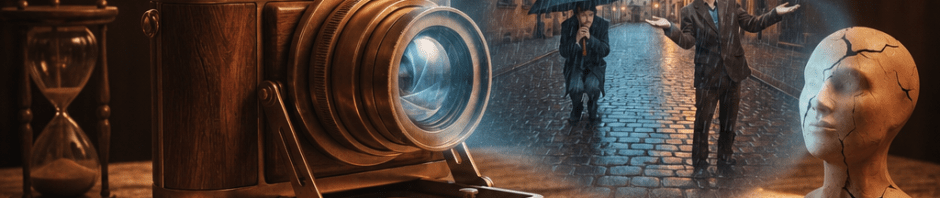
We are often told that we are the product of our experiences—that life is a sculptor and we are the clay, passively molded by every strike of fortune or catastrophe. But Edison’s legendary reaction suggests we have the dynamic entirely backward. What if we are not the clay at all, but the camera? The world provides the landscape, but our inherent nature dictates the focus, the exposure, and the lens. Who we are does not begin with what happens to us. Instead, experience meets us, and we meet experience. From that fundamental encounter, the cause and effect of a human life unfold.
The Filter of the Inherent
Consider a more everyday collision: two people are caught in the exact same sudden rainstorm. One feels a surge of childlike wonder, while the other spirals into frustration over ruined shoes. The external reality is identical, yet the internal outcomes are opposites.
In psychology, this is known as a reactive gene-environment correlation. The world is never entirely neutral; it is filtered through our baseline neurochemistry and genetic predispositions. We observe, process, and respond to each event based on our existing internal architecture. The experience does not create our traits; our traits decide how the experience is translated.
Shifting Lenses, Saving the Core
This raises a fascinating question: when we grow, what is actually changing? If a naturally anxious person learns mindfulness and becomes a calm leader, have they fundamentally altered their identity?
Not quite. There is a beautiful distinction in personality science between core traits and characteristic adaptations. Life events give us new perspectives, but they rarely erase our baseline blueprint. Instead, we adapt our lens. The anxious person remains inherently sensitive to stress, but they have built a sophisticated psychological toolset to manage the output. The core remains intact, but the outlook shifts. We do not become different people; we just become more adept at navigating who we already are.
The Curious Threshold
Yet, science offers a compelling plot twist to this philosophy through the field of epigenetics. While our core blueprint is stubborn, extreme environments can actually flip biological switches. Severe trauma or prolonged, intense stress can structurally alter the brain’s alarm system—the amygdala. In these rare, high-stakes scenarios, experience does more than offer a new perspective; it rewrites the baseline chemistry.
For the most part, however, life is a collaborative dance. We are born with a unique chemical melody, and life provides the rhythm. We cannot control the tempo of the experiences that meet us, but our inherent self always decides how we dance to them. We are not passive notebooks waiting to be written on. We are the authors, translating the raw material of the world into the story of ourselves.
Think about it: If you were caught in the sudden rainstorm mentioned above, would you be the one dancing in wonder or cursing your ruined shoes? How does your daily life reflect your inherent “lens”?


 freedup7
Amazing post!😲👍✨✨✨
Thank you for reading and responding, Hitiomi! I appreciate it!
🥰👭💕💕💕
💕
Truly precious, Betty! Love this perspective and how you unfolded this subject. Yes, while we cannot control all events life brings about, we certainly come with a “melody” and are free to decide how to dance with the rythms of life. Our conditioning and traumas may interfere with this, and that is why it is important to know and work on ourselves. Thank you for this “illuminating” post. Taking this question with me: “What if we are not the clay at all, but the camera?” Sending light and blessings your way, dear friend! ✨🙏💖🌻🌈
Thank you, Susana, for your reflective response!
I’m grateful that you found the post illuminating.
That question—“What if we are not the clay at all, but the camera?”—really does invite reflection, doesn’t it?
Thanks again, Susana, for your enlightening engagement!
Sending you light and blessings as well. ✨🙏💖
Love this
Thanks!