The Title of My Biography

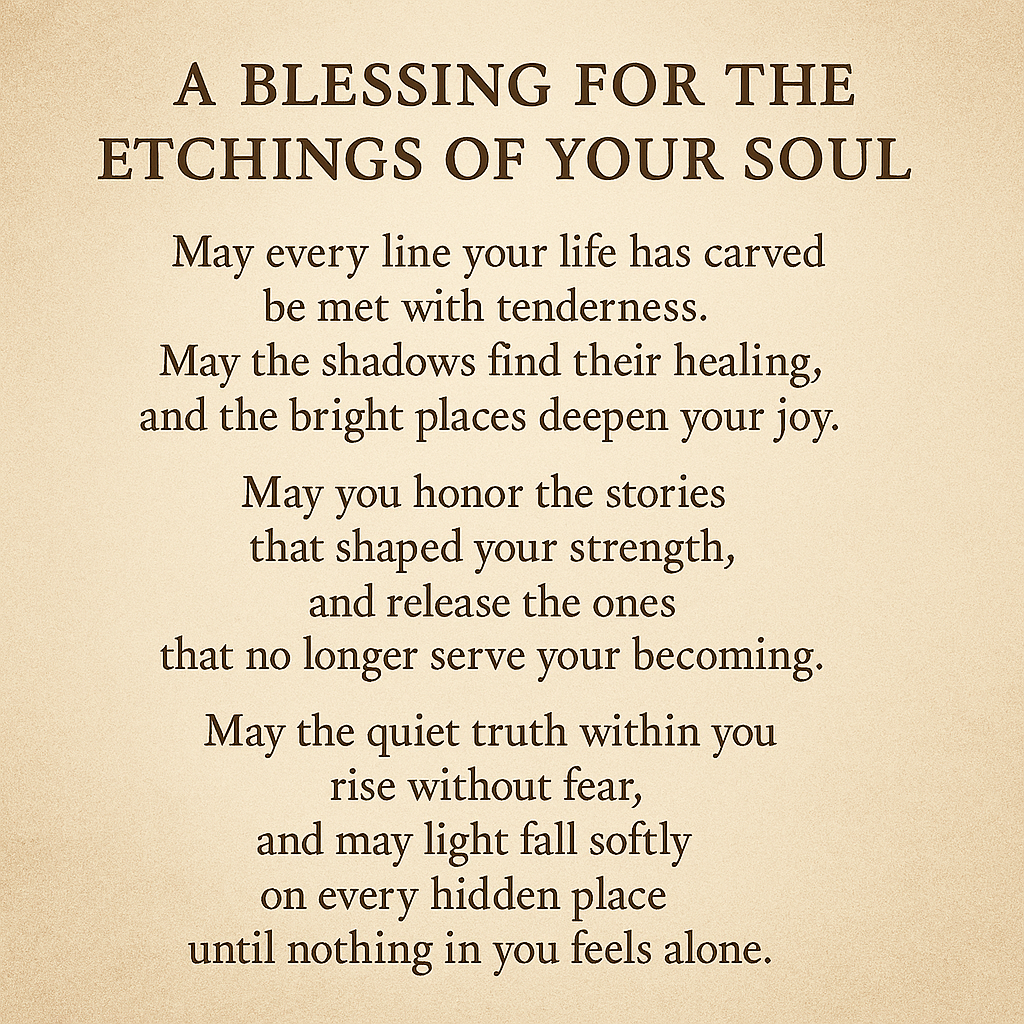
Create a symbolic, contemplative image for a blog titled “Etchings of My Soul”: a soft, luminous background in warm neutrals; a 5x5‑inch square composition; a single sheet of textured parchment at the center; faint hand‑drawn lines, swirls, and abstract markings emerging like soul‑impressions; gentle light radiating from behind the page; subtle hints of gold to suggest depth, memory, and inner truth.

Etchings of My Soul

Each day leaves a mark.

Some etched in joy, others carved by sorrow.

But all — every line, every shadow — belongs to the story unfolding within.

Not erased, not hidden.

Just held, honored, and offered.

The soul does not forget.

It sketches the truth in quiet strokes and waits for the light to reveal what has always been there.

Posted in Uncategorized | Tagged , , , , , , | 2 Comments

THE INHUMANITY OF A BROKEN HEART

A Narrative of Love, Loss, and the Hope for a More Compassionate World

There was a woman who loved with her whole heart. She didn’t know how to love halfway — she loved thoroughly, sincerely, and with a kind of innocence that made her believe others would do the same. She saw the world through rose‑colored glasses, trusting easily, hoping sincerely, and believing that people would honor the softness she offered.

But life taught her otherwise.

Again and again, she found her heart in the hands of people who did not know how to hold it. Some were careless. Some were selfish. Some were simply unprepared for the depth of her sincerity. And each time, when the relationship ended, she felt not just sadness, but a kind of inhumanity. A coldness, a lack of accountability. The person’s refusal to acknowledge the emotional and mental impact of their actions.

She often wondered, Why is it so hard for people to admit when they’ve hurt someone? Why is compassion so rare at the end of a relationship? Why do some walk away as if the heart they broke was never real?

As she grew older, she gained wisdom. She learned to understand people better — their wounds, their immaturity, their fears, their emotional limitations. But even with understanding, the question remained: Why couldn’t they show more humanity?

She remembered her own divorce — a painful chapter, but one that taught her something profound. After the storm settled, she found the strength to say, “You were an excellent provider. I appreciate the time we shared, and I wish you well.” That moment didn’t erase the pain, but it gave the ending dignity. It reminded her that even when love fails, compassion doesn’t have to.

Not every relationship ends with kindness. Not every person takes responsibility. Not every heart knows how to be gentle.

But she also learned something else: we must examine our own part in the story.

Sometimes she rushed in too quickly. Sometimes she ignored her intuition. Sometimes she believed words instead of watching actions. Sometimes she loved someone’s potential instead of their reality.

And sometimes, she did everything right — and still got hurt.

She realized that relationships are not just emotional experiences; they are growth experiences. They test our character. They stretch our emotional capacity. They reveal our insecurities, strengths, blind spots, and spiritual maturity. They show us who we are — and who we are becoming.

But she also saw the darker side of love: Some hearts grow cold. Some people enter relationships with selfish motives. Some use affection as a game. Some manipulate, gaslight, or deceive. Some never intended to build anything real.

And the genuine person — the one who came with sincerity — ends up carrying the weight of someone else’s brokenness.

Still, she refused to let bitterness win. She refused to let her heart harden. She refused to let the inhumanity of others define her capacity to love.

Instead, she began to desire something better — not just for herself, but for humanity.

She imagined a world where people entered relationships with compassion, honesty, and emotional responsibility. A world where breakups didn’t require cruelty. A world where people apologized when they were wrong. A world where empathy was the foundation, not the exception. A world where communication was clear, listening was intentional, and love was not a weapon but a gift.

She imagined future generations growing up with these values — learning from the beginning to love with maturity, to end relationships with dignity, and to care about the emotional impact of their actions.

She imagined a world where hearts didn’t have to break so violently.

And in that vision, she found hope.

Because even though she had endured the inhumanity of heartbreak, she still believed in the humanity of love. She felt that souls could grow. Minds could mature. Spirits could evolve. And that one day, compassion would become the standard — not the exception.

Her story was not just about pain. It was about awakening. It was about transformation. It was about the possibility of a more loving world.

And she hoped that by sharing her truth, someone else — maybe many others — would learn to love better, heal deeper, and treat every heart they encounter with the humanity it deserves.

In Conclusion

As the woman reflected on everything she had lived through — the tenderness, the heartbreak, the lessons, the awakenings — she realized something deeper about love and humanity. Relationships don’t rise or fall by accident. The inner world of the people involved shapes them.

She began to see that the way a person thinks, the condition of their soul, their level of compassion, sincerity, empathy, and emotional maturity all determine how they show up in love — and how they leave it. Mindset matters. Life experience matters—spiritual growth matters. Ego, wounds, and unhealed places matter too.

She understood now that relationships are not just about compatibility; they are about character.

And she couldn’t help but imagine how different the world would be if more people entered relationships with a renewed spirit — with kindness, accountability, emotional awareness, and a genuine desire to care about how their actions affect another human being.

What if compassion became the norm? What if honesty were expected? What if communication were clear, listening were intentional, and love were treated as something sacred rather than disposable?

She imagined children growing up watching adults model these values — learning from the beginning how to love with maturity, how to apologize with humility, how to end relationships with dignity, and how to treat every heart with humanity.

If these principles were embraced, she believed the world would change. Not instantly, but generation by generation. Quietly, steadily, beautifully.

And perhaps that is the true hope hidden inside every heartbreak — that the pain we survive becomes the wisdom we pass on, and the compassion we longed for becomes the compassion we teach.

Posted in Uncategorized | Tagged , , , , | 2 Comments

Taking Your Time: A Relationship Lesson for Every Generation

There was once a woman who had lived long enough to understand that love is beautiful, but it can also be costly when rushed. She had seen people of every age — teenagers, young adults, even elders — leap into relationships before truly knowing the person standing before them. She had watched hearts break, trust crumble, and dreams dissolve simply because no one taught them how to slow down.

So she decided to approach dating differently.

Whenever she met someone new, she didn’t rush to exchange numbers or make weekend plans. Instead, she treated the first meeting like a gentle conversation — a chance to observe, to listen, and to feel the energy between them. She called it her “interview,” though it never felt formal. It was simply her way of learning who a person really was before letting them into her life.

She would ask simple questions:

“What do you enjoy doing?” “Do you like cooking?” “How were you raised?” “What does partnership mean to you?”

She wasn’t being nosy. She was gathering the information that mattered — the kind that reveals whether someone is kind, responsible, emotionally mature, or simply looking for someone to take care of them.

And she always paid attention to the small things: Did their words match their actions? Did they follow through? Did they listen? Did they respect her boundaries?

If something felt off, she didn’t ignore it. She trusted her instincts. She had learned that red flags don’t disappear — they grow.

For the first meeting, she always chose a public place. A café, a bookstore, a busy park. Somewhere, she could observe the person without pressure. She believed the first impression wasn’t about romance — it was about safety, clarity, and truth.

If the first meeting felt good, she didn’t jump into a relationship. She simply scheduled another conversation. And another. She allowed the connection to unfold naturally, without forcing it. She believed that comfort and trust should grow slowly, like a plant that needs sunlight and time.

Only after a few meetings — when the energy felt right, and the person showed consistency — would she move to what she called “level two.” That meant light, fun outings: a movie, a new restaurant, skating, a museum. She loved these moments because they revealed different sides of a person. How they handled crowds. How they treated strangers. Whether they could laugh at themselves. Whether they were patient or easily irritated.

And through it all, she communicated openly.

She would say things like: “I’m enjoying getting to know you.” “How do you feel about our connection so far?” “Do you think we’re moving at a good pace?”

She believed honesty was a gift — not just to the other person, but to herself.

Most importantly, she reminded herself that dating is not a relationship. Dating is the process of discovering whether a relationship should even begin. It has a purpose and a timeline. When both people felt aligned, comfortable, and ready to label their connection, then — and only then — did she consider it a relationship.

Her approach wasn’t old-fashioned. It wasn’t modern. It was timeless.

And people of every generation — young, middle-aged, and seasoned — began to see the wisdom in it. They realized that slowing down wasn’t about fear. It was about clarity. It was about protecting their hearts. It was about choosing with intention instead of impulse.

Because love is not a race. It’s a journey. And the ones who take their time often end up with the most beautiful story.

Posted in Uncategorized | Tagged , , , , | Leave a comment

My Approach to Budgeting: Living Simply, Living True

My approach to budgeting is rooted in simplicity. I’ve learned that life feels lighter when I honor what I truly need rather than what I want. I don’t crave many things, and I don’t chase after excess. Instead, I focus on what supports my well‑being, my peace, and my daily rhythm.

Food is one of the clearest examples. I eat in a way that feels good to my body — mostly vegetarian, light, and clean. I avoid too many sweets, and I don’t buy foods that leave me feeling weighed down. When I go to the market, I don’t wander or browse. I know exactly what I need and which aisle to find it. I buy what I enjoy eating, what nourishes me, and what keeps my meals simple. Sometimes I add a touch of beauty to my home, like fresh flowers. That alone brings joy without clutter.

The same principle guides my wardrobe. I buy what I need for each season — no more, no less. I keep my clothing minimal because I prefer not to be overwhelmed with choices or laundry. Each season, I refresh my wardrobe with five or six new outfits and give away items from the previous season. This keeps my closet clean, intentional, and easy to manage. Since I don’t enjoy domestic chores, keeping only the essentials helps me maintain order without effort.

Living this way keeps my budget steady and predictable. I’m not constantly buying, replacing, or accumulating. I’m simply choosing what aligns with my lifestyle and letting go of what doesn’t. There’s a quiet joy in that — a freedom that comes from not being owned by things.

Simplicity isn’t deprivation. It’s clarity. It’s choosing what matters and releasing what doesn’t. It’s living within my means while living fully within myself.

And for me, that is sufficient.

Posted in Uncategorized | Tagged , , , | 2 Comments

Part III — The Awakening Within: When the Inner Light Begins to Lead

There was once a woman who lived her life the way most people do — shaped by expectations, guided by rules, and pulled in every direction by the voices around her. She followed what she was taught, believed what she inherited, and behaved according to the systems that raised her.

But something inside her always felt unsettled.

She sensed there was more to life than obedience, more to morality than fear, more to identity than the labels society handed her. She felt a quiet stirring, a whisper that did not come from culture, doctrine, or authority.

It came from within.

One morning, while sitting alone before the world awakened, she felt a shift — subtle but unmistakable. It was as if a veil had lifted. She realized that the guidance she had been seeking outside herself had been speaking inside her all along.

Not loudly. Not forcefully. But steadily, like a soft flame that had waited patiently to be noticed.

She began to trust that inner voice — the one that nudged her toward compassion, truth, courage, and clarity. The more she listened, the more she recognized it as something ancient, sacred, and felt like home.

This was the beginning of her awakening.

The Moment Consciousness Turns Inward

Most people live outwardly — reacting to the world, absorbing its noise, shaped by its narratives. But awakening begins the moment a person realizes:

“I am not here to be shaped by the world. I am here to shape my inner world first.”

This shift is not dramatic. It is not loud. It is not a lightning strike.

It is a quiet reorientation — a turning inward.

And once it begins, the world outside loses its power to define, divide, or control.

The Rise of Inner Authority

As the woman continued listening to her inner guidance, she noticed something remarkable:

She no longer needed validation from systems. She no longer feared disapproval. She no longer felt compelled to follow the crowd.

Her decisions became clearer. Her boundaries became stronger. Her compassion became deeper.

She was no longer governed by external laws, ideologies, or expectations. She was governed by something far more trustworthy:

Her awakened conscience. Her inner light. Her spiritual intelligence.

This is what it means to evolve. Not to abandon the world — but to stop being ruled by it.

Why Most of Humanity Has Not Yet Awakened

Awakening requires courage. It requires silence. It requires the willingness to question inherited beliefs.

Most people are not ready for that.

They cling to external systems because it feels safer to be told what to think than to discover who they truly are. They fear the responsibility that comes with inner freedom. They fear the uncertainty of self-governance.

And so they remain spiritually asleep — guided by noise instead of wisdom, by conditioning instead of consciousness.

But those who awaken… Those who begin to listen inwardly… Those who trust the law written on their hearts…

They become the ones who shift the world.

The Birth of a New Humanity

The woman eventually realized something profound:

Awakening is not a personal achievement. It is a contribution to humanity.

Every person who becomes internally governed weakens the power of extremism, propaganda, and division. Every person who listens to their inner light strengthens the collective light of the world.

Awakening is contagious. It spreads quietly, soul to soul, heart to heart.

And one day, humanity will reach a tipping point — when enough people have turned inward, when enough hearts have awakened, when enough spirits have remembered who they are.

That is when the world will change.

Not through laws. Not through systems. Not through force.

But through consciousness.

Posted in Uncategorized | Tagged , , , , , , , | Leave a comment

Part—II Being a Law Unto Oneself

The Weight of External Laws

Throughout history, people have been shaped — and often controlled — by external systems. Governments, religions, ideologies, philosophies, and political doctrines. These structures have offered identity, certainty, and direction. But they have also created dependence.

Most people look outward for guidance because they have never learned to trust the voice within.

And when the inner compass is silent or undeveloped, the mind becomes vulnerable. Vulnerable to manipulation. Vulnerable to extremism. Vulnerable to any ideology loud enough to fill the void.

This is how fanaticism grows: Not from evil hearts, but from empty ones.

The Other Way of Being

But there is another kind of person — rare, but unmistakable.

They do not need a new ideology to tell them what is right. They do not wait for laws to define their morality. They do not outsource their conscience to institutions or leaders.

Their integrity rises from within, woven into their character, their awareness, their very being. They are not rebellious — they are rooted. They are not anarchic — they are aligned. They are not lawless — they are internally governed.

They are, in the truest sense, a law unto themselves.

And because of this, they cannot be easily swayed by propaganda, fear, or political reflexes. They do what is right because it is who they are — not because someone told them to.

The Fragility of a Society Without Inner Guidance

A society becomes fragile when its people depend entirely on external authority to tell them how to live, what to believe, or who to follow. Laws can regulate behavior, but they cannot transform the inner condition of the human spirit.

When people lack internal grounding:

  • They cling to ideologies for identity
  • They follow leaders without discernment
  • They become reactive instead of conscious
  • They mistake obedience for morality
  • They confuse loudness with truth

This is why humanity remains vulnerable to cycles of extremism and division. Not because people are inherently destructive — but because they have not yet awakened to the guidance already written within them.

The Unfinished Work of Human Consciousness

Most of humanity has not yet ascended into inner awareness. Many still live from the outside in — shaped by culture, conditioned by systems, and guided by inherited beliefs rather than inner knowing.

But those who begin to listen inwardly… Those who begin to trust the quiet wisdom of conscience… Those who begin to live from spirit rather than fear…

They become the ones who shift the world.

Not through force. Not through ideology. But through the simple, powerful act of being internally governed.

They become living proof that the highest law is not written on stone tablets or political platforms — it is written on the human heart.

Posted in Uncategorized | Tagged , , , , , | Leave a comment

Part 1— A Story of the Law Written on the Heart

There was once a man who lived far from temples, scrolls, and religious instruction. He had never studied commandments, never memorized sacred laws, never sat under the teaching of priests or scholars. To many, he would have been considered “unchurched,” a man without guidance.

Yet everyone in his village trusted him.

When a widow’s roof collapsed, he was the first to arrive with tools in hand. When a child cried from hunger, he shared his own food without hesitation. When conflict arose, he listened before speaking, and when he spoke, his words carried peace.

People often wondered how he knew what was right. He would smile and say, “I just do what my heart tells me.”

One day, a traveling teacher passed through the village. He watched the man quietly—how he treated strangers with dignity, how he forgave quickly, how he lived with a gentleness that seemed to come from somewhere deeper than habit or culture.

The teacher finally approached him and asked, “Who taught you to live this way? Which laws do you follow?”

The man looked puzzled. “Laws? I don’t know any laws.”

The teacher nodded slowly, recognizing something sacred. “You are what the Scriptures call a law unto yourself,” he said. “Not because you reject what is written, but because the law is already written within you.”

The man didn’t fully understand, but the teacher continued:

“Some people follow rules because they fear punishment. Others follow them because they were told to. But then there are those—like you—who follow what is right because their conscience speaks louder than any command. You live from the inside out. That is the truest form of obedience.”

The man listened quietly, humbled.

“You see,” the teacher said, “God’s moral law is not only ink on scrolls. It is etched into the human heart. Some people need to read it. Others live it.”

And with that, the teacher blessed him and went on his way.

The villagers never forgot that moment. They realized that holiness was not always found in rituals or recitations, but in the quiet, instinctive goodness that flows from a heart aligned with truth.

The man continued living as he always had—kindly, humbly, instinctively guided by something greater than himself. But now he understood:

He wasn’t following any law. He was following the law written within him.

Posted in Uncategorized | Tagged , , , , , , , , | Leave a comment

The Next Evolution: Rising Above Racial Conditioning  

We live in a world where the first thing many people notice about another human being is the color of their skin. Before a word is spoken, before a soul is felt, before a story is known, the eyes make a judgment. And too often, that judgment is shaped not by truth, but by conditioning.

Skin color is a genetic detail — nothing more. It is no different in essence than eye color or hair texture. Yet society has treated it as destiny, as hierarchy, as identity. Entire histories have been shaped by how skin tone has been perceived, weaponized, and misunderstood.

But skin color does not think. It does not speak. It does not act. People do. And people act from their experiences, their struggles, their environments, their traumas, their hopes, and their histories — not from the melanin in their skin.

For many, especially African Americans, skin color became intertwined with a legacy of oppression, survival, and resilience. Not because skin color defined them, but because society used it as a tool to confine them. The world projected stereotypes onto them, judged their behavior without understanding their battles, and mistook survival strategies for character flaws.

Yet the truth remains: Behavior is shaped by circumstance, not complexion. Identity is shaped by spirit, not skin.

Still, discrimination persists. People are mistreated, dismissed, or feared simply because they do not resemble the so‑called “majority.” This majority is often upheld by systems that have historically placed white skin at the top of the economic and social hierarchy — not because of inherent superiority, but because of centuries of conditioning.

But something profound is happening. Humanity is evolving.

Interracial marriages, multicultural families, and global interconnectedness are expanding the human gene pool and dissolving old boundaries. Children are being raised with broader worldviews, freer spirits, and clearer eyes. They are learning to value souls, not skin tones. They are rejecting the subconscious inheritance of outdated prejudices.

They are becoming the generation that sees humanity as a shared resource — a collective brilliance meant to uplift, innovate, and transform the world.

Every human being longs for the same thing: To be seen. To be valued. To be treated as a sacred life with inherent worth.

When we interact with one another, it is not skin that meets skin — it is soul meeting soul. It is spirit recognizing spirit. It is energy responding to energy. Pain, joy, loneliness, hope — these are not felt by the body but by the inner being.

So when someone judges another by skin color, what they reveal is not the truth about the other person, but the truth about themselves. They reveal conditioning. They reveal fear. They reveal a lack of spiritual evolution.

Racism is not a sign of superiority. It is a sign of unconsciousness.

It is a sign that a person is still living inside a small, inherited box — a box built from ego, illusion, and generational programming. A box that keeps them from awakening to the fullness of their own humanity.

But we are not meant to live in boxes. We are meant to evolve.

To rise beyond the superficial. To see with spiritual eyes. To recognize the divine in every face, every culture, every shade of human expression.

The future of humanity hinges on our capacity to transcend the illusions that have historically divided us. Once we recognize that skin color is simply a physical attribute — and that it is the soul and spirit that define our humanity — we will steep into a higher state of collective consciousness.

And in that consciousness, humanity will flourish as one.

Posted in Uncategorized | Tagged , , , , , , | Leave a comment

Are You Patriotic? A Reflection Beyond Borders

Patriotism is a powerful word—one that stirs emotion, memory, and identity. But before answering whether I am patriotic, I must first ask: What does patriotism truly mean?

I hold deep respect for the concept of patriotism and for those who have sacrificed under its banner. Yet my understanding of patriotism is not confined to the borders of a single nation. My spirit does not recognize limits on compassion, dignity, or collective responsibility. I believe in a patriotism that honors humanity itself—a patriotism expansive enough to embrace all nations, all peoples, all lives.

I honor the rights, liberties, and freedoms of every individual. But when patriotism becomes exclusive—when loyalty is directed only inward, toward one’s own country—it fractures the human family. It breeds division, discrimination, and ego-driven individualism shaped by conditioning rather than consciousness. This narrow form of patriotism restricts spiritual ascent and stunts the evolution toward full awareness.

Governments do not grant true freedom; it is cultivated within. When individuals become internally free—mentally, emotionally, and spiritually—their nations will reflect that freedom in their policies, their culture, and their collective well-being. Spiritually, there will be no labels!

Members of my own family have served in the name of “freedom” in the United States. I understand the weight and the reality of patriotism. Yet my heart has always held compassion for every life lost—on all sides of conflict—and for every family left to carry the grief.

I cannot confine patriotism to rigid boundaries. I appreciate the struggles, milestones, and hard-won freedoms that have shaped the United States. I live here, and I have benefited from those sacrifices. But history is not simple. Patriotism has not always been extended to everyone. Many remember the exclusions, the racism, the prejudice, the forced assimilation, and the denial of citizenship and dignity. One cannot claim to love patriotism while ignoring the scars carried by those who fought for rights they were never fully granted.

Yes, civil rights have progressed. Yes, democracy has expanded. But the journey is far from complete. Barriers rooted in skin color, gender, identity, and ideology persist. What I honor most is not nationalism—it is the struggle that has brought transformation, the courage that has pushed this nation closer to humane and spiritual ideals, and the resilience of those who fought not just for themselves but for the generations that would follow.

Humanity has come far, but we still have a long way to go in healing the wounds created by human inhumanity.

So no, I do not place myself inside a one-nation patriotic box. I choose instead to identify as someone who sees the sacredness of every life, regardless of geography. The human race is one family, and every person deserves love, dignity, respect, and liberty.

These truths must be written in the constitution of hearts, souls, and spirits. Until humanity internalizes love for one another, a unified world cannot flourish.

When that day comes, labels will fall away. Borders will lose their power to divide. And what will remain is a single, unified humanity, flourishing as one. Just as our Creator designed us—rooted in spirit, expansive in love, and destined to live as one human family!

Posted in Uncategorized | Tagged , , , , , , | 2 Comments

Reborn From Within: My Journey Beyond Tradition, Religion, and External Influence

During my thirties, I awakened to a truth that had been quietly shaping my life for decades: I had been deeply influenced—almost conditioned—by tradition and religion. This realization was not a crisis; it was an invitation. An invitation to examine the origins of my beliefs, the roots of my decisions, and the forces that shaped my identity.

Once I saw it, I could not unsee it. And so I began the work of deconditioning.

I resolved that I would no longer make choices based on tradition or religious expectation. Instead, I wanted to reconfigure my mind—to think, feel, perceive, and decide from a place that was authentically mine. I wanted to be reborn from within.

Of course, reconfiguring the mind is not an overnight transformation. It took a lifetime to build the old patterns, and it took time to unravel them. I often caught myself slipping back into familiar habits, but each time I noticed it, I gently redirected myself. I became intentional about the shift.

For years, I attended church every Sunday and read the Bible faithfully. I do not regret a single moment of that season. The teachings, principles, and wisdom I encountered were invaluable. But one day, a question rose from deep within me:

“Would you feel and act the same if you didn’t go to church or read the Bible?”

That question changed everything.

I wanted to experience my spirit—my soul—without the influence of organized structures, sermons, or religious routines. I wanted to know who I was without those external voices. What remained when all the noise fell away?

What I discovered was profound.

I became aware of myself in a new way. I learned to listen to my innermost being. I experienced my spirit without filters, without intermediaries, without external reinforcement. And I found it deeply gratifying.

I realized that I prefer to make choices based on my own understanding of who I am—not on tradition, not on expectation, not on inherited beliefs. So I stepped away from church services and set aside the Bible for a time. This does not mean I will never return to it. The Bible holds profound wisdom, and it was my first gateway into spirituality. I am grateful for every lesson it offered.

But now, my mind is clear. I no longer adopt ideas prematurely. I reflect, research, and think critically. I keep my eyes open.

Today, I am at peace. I no longer feel compelled to dissect the mysteries of life or chase endless questions. I am harmonious, grounded, and satisfied with myself and with life. I am blessed, thankful, and grateful for the freedom I feel within.

I remain present. I release control. I observe what unfolds.

And in that quiet, spacious awareness, I find that answers reveal themselves—not as beliefs, but as knowing. Knowing who we are. Why are we here? Where do we come from? And how the spirit within us speaks when everything else grows silent

Posted in Uncategorized | Tagged , , , , , , , | Leave a comment