
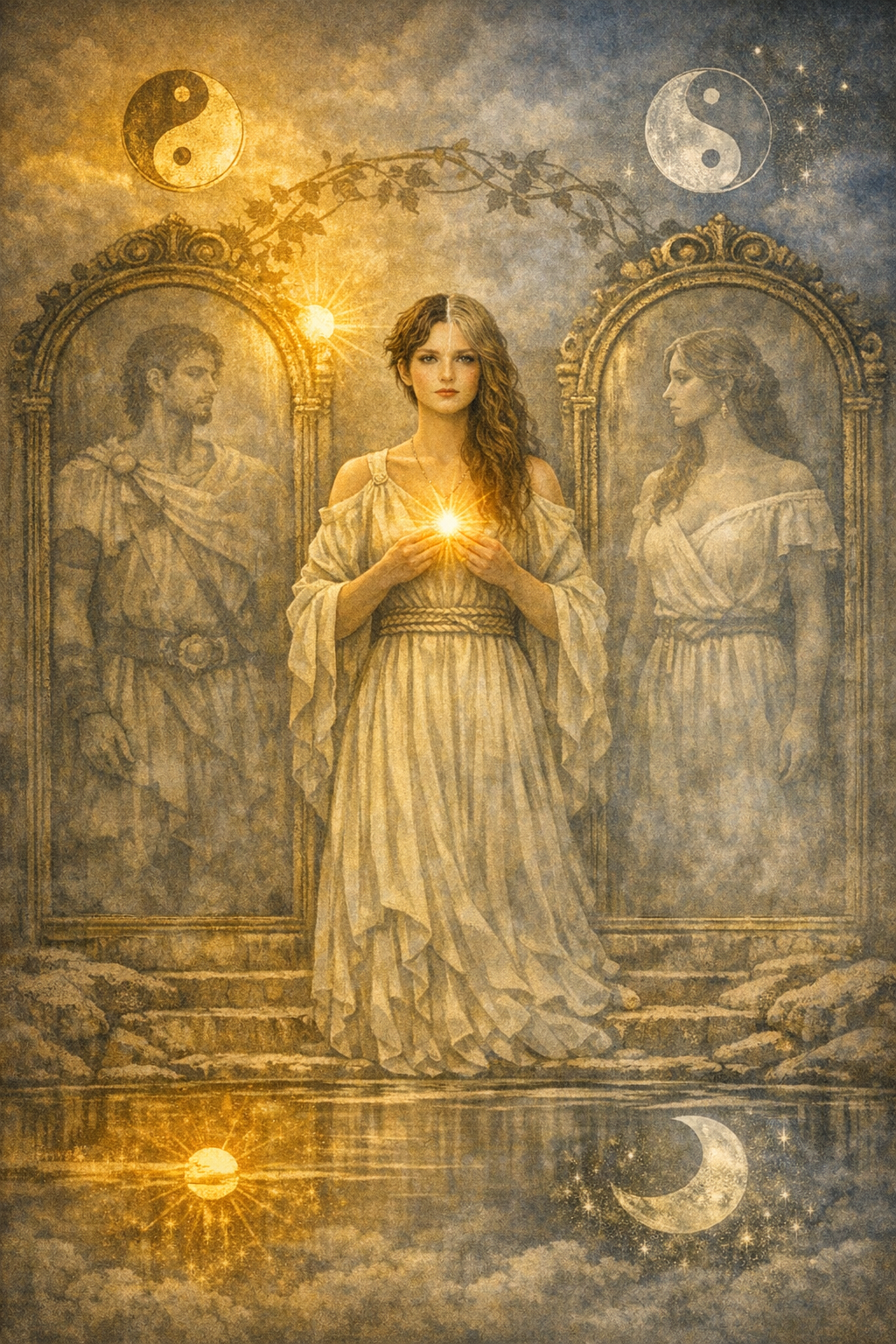
She had always sensed there was more to being human than the surface suggested. It was more than bone and breath. It was more than personality and preference. She had never felt that truth as sharply before. That changed after the encounter that stirred something ancient inside her.
The moment had passed quickly, almost too quickly to grasp. A stranger with an unusual energy, an apartment that felt like a sanctuary, and then—like a whisper rising from the marrow of her being—a revelation:
“I don’t feel whole. A part of me is missing.”
The words had not come from her mind. They came from deeper—somewhere in the quiet architecture of her soul.
But afterward, as she sat with the echo of that moment, another question surfaced. A question that reached beyond emotion and into the very structure of human existence:
If both male and female are written into the human blueprint, then what does wholeness truly mean?
She had heard the biological facts before: That every embryo begins with the potential for both paths. The earliest form of human life carries the template for male and female structures. That hormones, timing, and genetic switches determine which path unfolds. That some rare individuals are born with both sets of organs, or variations in between.
Science called it development. Spirit called it design. She wondered if it might be both.
As she walked through the quiet of her home that evening, the thought deepened. It wasn’t about anatomy. It wasn’t about gender. It was about something older, something woven into the human story long before biology had words for it.
Duality. Complementarity. The two-in-one nature of being human.
She imagined the human soul as a seed. It contains both the masculine and the feminine. It embodies the active and the receptive. It includes the giving and the yielding. Not opposites, but partners. Not halves, but harmonies.
Some people, she realized, spend their lives seeking their missing half in another person. Others spend their lives awakening the dormant half within themselves.
Both paths were real. Both paths were ancient. Both paths were valid.
But which one belonged to her protagonist?
She imagined her fictional character—let’s call her Arielle—standing at the threshold of that beautiful apartment, feeling the ache of incompleteness. Not because she lacked someone, but because something inside her had been stirred awake.
Arielle began to wonder:
- Was the vision pointing her toward a soulmate?
- Or was it pointing her inward, toward a part of herself she had not yet met?
- Was wholeness something found in another person, or something cultivated within?
- Or could it be both—two different expressions of the same truth?
The more she explored the question, the more she realized that human beings were not designed as fragments. They were designed as possibilities.
Some people find wholeness through union—two souls resonating like matched frequencies. Others find wholeness through integration—awakening the masculine courage within their feminine softness, or the feminine intuition within their masculine strength.
Arielle saw that the blueprint of humanity held both potentials. The body chose one path. The soul carried both.
Perhaps the ache she felt wasn’t a sign of lack. Instead, it was a sign of awakening. It was an invitation to explore the full spectrum of who she was created to be.
Maybe her other half was a person. Maybe her other half was a part of herself. Maybe it was both, unfolding in time.
But the vision had done its work. It had cracked open a door inside her. It had shown her that wholeness was not a single destination, but a landscape with many paths.
And as she sat in the quiet of her room that night, she realized something profound:
The human soul is not incomplete. It is unfinished. And every revelation—whether sparked by a stranger, a moment, or a memory—is part of its becoming.


 freedup7