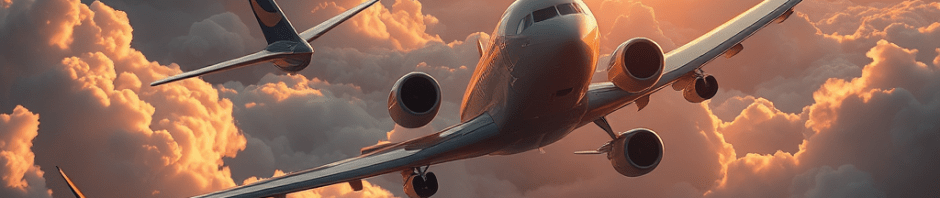
Before artificial intelligence expanded our imagination of what machines could do, I believed the airplane was humanity’s boldest triumph. The idea that a massive metal body—something that should by all rights remain earthbound—could rise into the sky with the grace of a bird felt almost miraculous. On warm evenings, I’d sit on my back porch and watch the sky as if it were a grand stage. Airplanes would glide across it, some close enough for me to see their lights blinking, others just silver strokes slipping between clouds. Whenever several appeared within seconds of each other, I felt a familiar thrill. How could so many be up there at once? And when birds drifted into view—sometimes in loose formation, sometimes alone—I wondered whether humans had borrowed their earliest lessons in flight from these feathered teachers.
It wasn’t until much later that I learned the truth: the sky is far busier than it looks. Thousands of airplanes crisscross the atmosphere at any given moment, moving along invisible highways. The realization startled me. The sheer volume of airborne traffic is mind‑bending, yet collisions are almost unheard of—far rarer than the accidents we see on the ground. Somehow, people on the earth below—controllers, pilots, engineers—manage this vast, silent ballet with astonishing precision. If only motorists had a system half as elegant.
That revelation stirred something in me. Curiosity tugged at me until I finally gave in. I wanted to understand the mechanics behind the magic. How does something so heavy stay in the air? What keeps it from falling? And how does its flight compare to the effortless glide of a bird?
So I began to learn. I studied lift, thrust, drag, and weight. I compared the living flexibility of a bird’s wing—feathers shifting, muscles adjusting—to the rigid, engineered design of an airplane’s airfoil. I discovered that while both rely on the same fundamental principles, they express them in beautifully different ways. The deeper I went, the more fascinating it became. I told myself, “If I ever decide to fly, I want to understand what’s holding me up there.” And with each new insight, the sky felt a little less mysterious and a lot more wondrous.
Now, when I look up and see a bird carving its path through the wind or an airplane tracing a line across the sky, I see more than motion. I see the forces at work, the physics, the instinct, the ingenuity. I see the quiet brilliance behind every flight.
And somehow, knowing the mechanics hasn’t diminished the wonder—it has only deepened it.
Questions:
What everyday wonder still has the power to lift your curiosity the way flight lifted mine?
When you look up at the sky, what mystery or marvel stirs your imagination?
What phenomenon, big or small, makes you pause and ask, “How does that even work?”


 freedup7