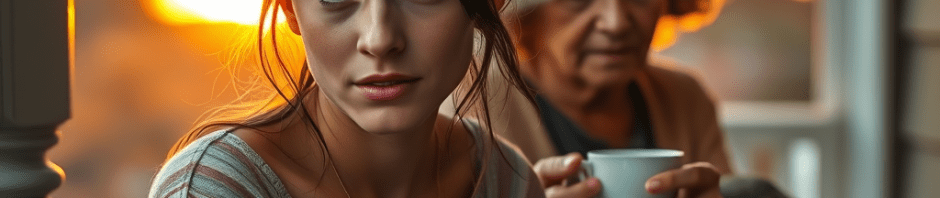
A Story About a Generation Trying to Breathe.
Mara’s Story
Mara sat on the edge of her grandmother’s porch, watching the sun sink behind the hills. She was twenty‑seven, but exhaustion clung to her like someone twice her age. Her phone buzzed beside her — another notification, another reminder that the world was always moving, always demanding, always watching.
Her grandmother, Lila, stepped outside with two cups of tea. She handed one to Mara and settled into the rocking chair beside her.
“You’re quiet today,” Lila said.
Mara let out a breath she didn’t realize she’d been holding. “I’m tired, Grandma. Not just physically. It feels like life is… too much. Like I’m already behind, and I haven’t even started.”
Lila didn’t rush her. She simply waited.
“It’s everything,” Mara continued. “The cost of living, the news, the pressure to be perfect, the fear of messing up. Everyone online looks like they’re thriving, and I’m just trying to keep my head above water. I feel like I’m failing at adulthood.”
Lila rocked gently, her eyes soft. “You’re carrying a weight you didn’t choose.”
Mara looked up, surprised.
“When I was your age,” Lila said, “life wasn’t easy — but it was steadier. If you worked hard, you could afford a home. Jobs lasted. Communities stayed together. We didn’t have to compare ourselves to the whole world every day. And when we struggled, we had people close by who noticed.”
She paused, letting the words settle.
“You grew up in a different world. One that changed faster than anyone could prepare you for.”
Mara swallowed. “Sometimes I feel like I should be stronger.”
Lila shook her head. “You are strong. But strength isn’t the same as being invincible.”
She leaned forward, her voice low and steady.
“You were raised in a time when children were protected from small struggles, so the big ones feel impossible. You were taught to name your feelings, but not how to carry them. You were given information, but not wisdom. Connection, but not community. And then the world handed you instability — pandemics, rising costs, uncertainty — and expected you to navigate it alone.”
Mara felt tears prick her eyes. “So it’s not just me.”
“No,” Lila said. “It’s your whole generation. You inherited a storm that started long before you were born.”
The porch grew quiet. Fireflies blinked in the yard, tiny lanterns in the dusk.
“So what do I do?” Mara whispered.
Lila reached over and took her hand. “You start by understanding that your struggle is not a personal flaw. It’s a sign of the times. And then you learn what the world forgot to teach you — resilience, boundaries, community, and patience with yourself. You build the things that should have been given to you.”
She squeezed Mara’s hand gently.
“And you remember that even in a storm, you don’t have to stand alone.”
For the first time in months, Mara felt something shift inside her — not a solution, but a softening. A sense that maybe she wasn’t broken. Maybe she was simply human in a world that had forgotten how to be gentle.
And sometimes, understanding is the first step toward breathing again.
A Note to Those Who Came Before Them
As we listen to Mara and Lila, it becomes clear that the struggles of today’s younger adults are not signs of weakness — they are signs of a world that shifted beneath their feet before they ever had a chance to find their balance. They inherited storms they did not create, and many are trying to build a life without the tools or support that earlier generations once relied on.
This is where we come in.
Those of us who have lived longer, who have weathered our own seasons of uncertainty, carry something they desperately need: perspective, steadiness, and the kind of wisdom that only comes from time. But wisdom is not useful unless it is shared. Strength is not meaningful unless it is offered. And understanding is not transformative unless it is expressed.
Younger generations do not need criticism. They do not need dismissal. They do not need to be told to “toughen up.”
They need to be met with compassion.
They need someone to say, “I see how heavy this feels.” They need someone to walk beside them as they learn resilience. They need someone who will teach without shaming, guide without controlling, and support without rescuing.
We can help them by:
- Listening without judgment, so they feel safe enough to speak honestly.
- Sharing our stories, not to compare struggles, but to show that hardship can be survived.
- Teaching practical skills — financial basics, conflict resolution, emotional boundaries — the things many were never taught.
- Offering community, even in small ways: a meal, a conversation, a place to belong.
- Encouraging patience, reminding them that growth takes time and that they are not behind.
- Modeling resilience, showing what it looks like to bend without breaking.
Every act of understanding becomes a lifeline. Every moment of patience becomes a seed of strength. Every gesture of support becomes part of the foundation they are trying to build.
We cannot change the world they inherited, but we can change the way they move through it — by taking their hand, steadying their steps, and reminding them that they do not have to navigate this life alone.


 freedup7