Why I Relate to Jean Valjean

When I think about the fictional character I relate to most, Jean Valjean from Les Misérables comes immediately to mind. His story is one of transformation, of being and becoming, and I see pieces of myself in his journey.

Valjean begins as a man defined by hardship and bitterness. His years in prison leave him hardened, suspicious, and weighed down by injustice. I understand that sense of carrying burdens from the past, of feeling shaped by circumstances beyond my control. Yet what makes Valjean remarkable is not where he starts, but how he chooses to change.

The turning point in his life comes when Bishop Myriel shows him mercy. That act of grace opens a door to a new way of living. I relate to Valjean here because I know what it means to be given second chances, to be offered kindness when I least deserved it. Like him, I have felt the power of grace to soften the heart and redirect the path.

As Valjean becomes a protector, a benefactor, and a man of compassion, I see qualities I aspire to. He learns to live not for himself but for others, carrying responsibility with courage. His love for Cosette, his willingness to sacrifice his own peace for her happiness, resonates deeply with me. I, too, want my life to be marked by selflessness, by the quiet strength of caring for others even when it costs me something.

What I admire most is that Valjean never stops becoming. He is not perfect, and he wrestles with fear and doubt, but he continues to grow. His identity is reshaped again and again by grace, compassion, and responsibility. That ongoing transformation mirrors my own journey. I am not finished; I am still becoming.

Jean Valjean reminds me that who I am today does not define who I can be tomorrow. His story is a living testament to the possibility of redemption, growth, and love. That is why I relate to him so deeply — because like Valjean, I am both being and becoming.

Posted in Uncategorized | Tagged , , , , , , , , | 11 Comments

The Architecture of the Harvest

A Creative Teaching on Consequence, Connection, and Divine Alchemy

Every life is a field, every choice is a seed, and every day is a harvest. We exist inside a flawless spiritual ecosystem governed by precise spiritual laws. To navigate this life with wisdom, we must understand the three distinct forces that shape our reality: the Law of Consequence (Sowing and Reaping), the Law of Exchange (Reciprocity), and the Law of Transformation (Divine Redemption).

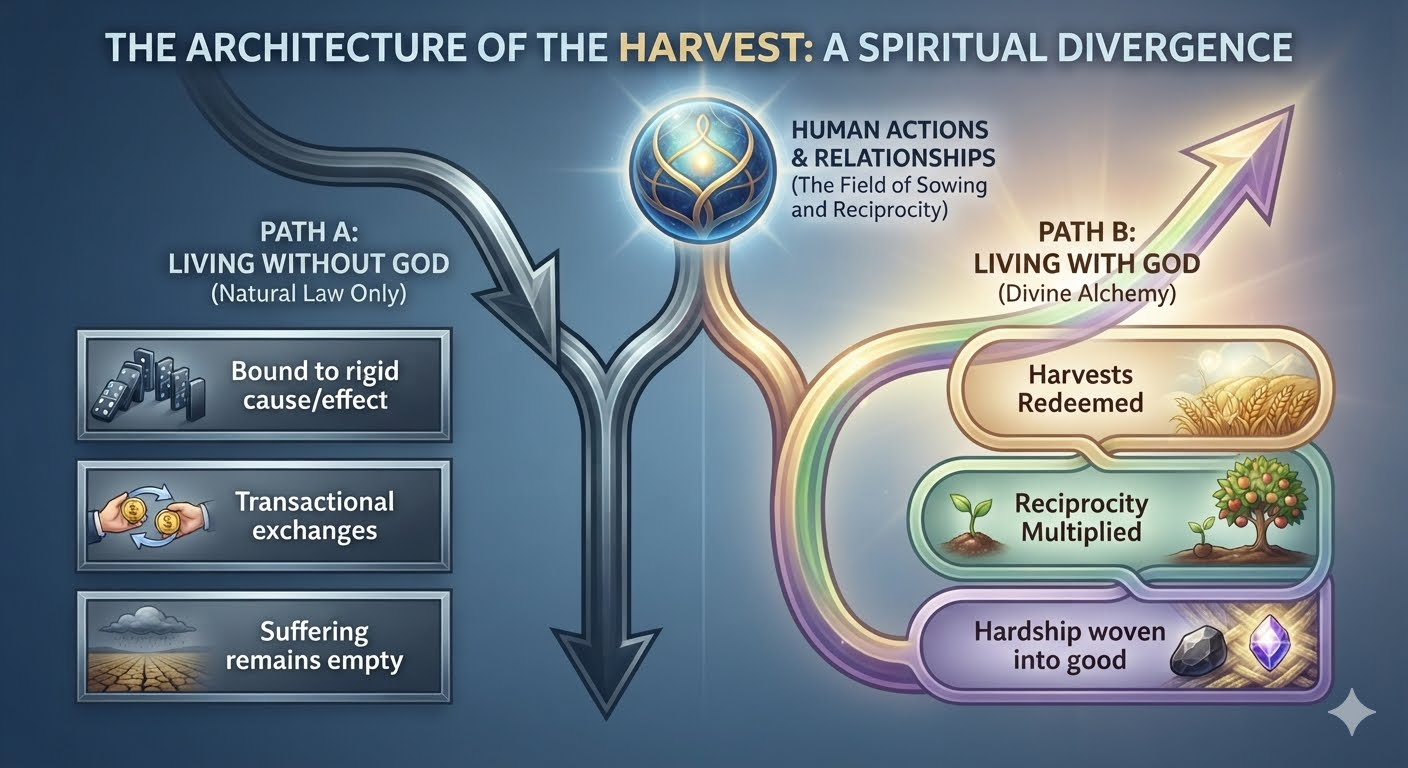
When these laws interact, they create a profound divergence in human experience. The chart below visually maps out how our personal actions and relationships split into two entirely different realities based on our spiritual alignment.

Part I: The Two Universal Laws of Creation

Before examining divine intervention, we must look at the two foundational laws that apply to every human being on earth, regardless of their beliefs.

1. Sowing and Reaping (The Law of Personal Consequence)

This is the natural law of cause and effect. Your actions are literal seeds planted into the fabric of time. What you put into the soil of life dictates exactly what grows out of it.

  • The Blueprint: Good seeds (kindness, generosity, honesty) yield blessings. Bad seeds (selfishness, cruelty, deceit) yield pain and destruction.
  • The Literal Reality: This law is unyielding and acts as a universal constant. If you plant an apple seed, you will get an apple tree; if you plant thorns, you will harvest briars.

2. Reciprocity (The Law of Relational Exchange)

While sowing and reaping deals with your personal actions, reciprocity governs your relational environment. It is the Golden Rule in active motion: “Do unto others as you would have them do unto you.”

  • The Blueprint: Human interactions are not isolated events; they are part of a continuous relational echo.
  • The Literal Reality: Kindness invites kindness. Hostility breeds hostility. What you extend to the world around you creates a relational feedback loop that ultimately shapes your community and immediate environment.

Part II: The Great Divide (The Catalyst of Romans 8:28)

The universal laws of consequence and exchange apply to everyone. However, a radical divergence occurs when we introduce the premise of Romans 8:28“We know that in all things God works for the good of those who love Him, who have been called according to His purpose.”

This promise is strictly conditional. It introduces a sharp contrast between a life lived in alignment with God and a life lived apart from Him.

Path A: Living Without God (The Natural Mechanics)

When a person lives strictly by their own rules and self-interest—even if they achieve monumental worldly success—they operate entirely outside of divine redemption.

  • The Harvest is Rigid: Sowing still functions perfectly. A person can sow tireless ambition and reap wealth, recognition, and influence. However, if they simultaneously sow neglect, harshness, or corner-cutting, they will naturally reap loneliness, mistrust, and fractured relationships.
  • The Relational Echo is Transactional: Reciprocity functions only on a human level. Kindness might bring human favors, and cruelty will bring resistance, but it lacks any eternal perspective or spiritual multiplication.
  • The Bottom Line: Without God, pain remains pain, and emptiness remains emptiness. When hardship strikes, there is no divine assurance to transform that suffering. The harvest is strictly bound to natural cause and effect, ultimately leading toward spiritual bankruptcy.

Path B: Living With God (The Redeemed Field)

When a person actively loves God and walks in His purpose, the natural laws of the universe do not vanish; instead, they are elevated and intercepted by a higher law—the law of divine redemption.

  • The Harvest is Redeemed: Human beings naturally make mistakes and sow poor seeds. But for those who love God, He transforms those negative consequences into vital lessons, character growth, and unexpected blessings.
  • The Relational Echo is Multiplied: Acts of love, faith, and quiet generosity do not just return naturally. God magnifies them, transforming simple human interactions into eternal, multiplying fruit.
  • The Ultimate Tapestry: Hardship, illness, and betrayal still happen. However, because of divine intervention, these painful periods are never wasted. Financial struggles are converted into absolute reliance on God; physical or emotional suffering is converted into deep, supernatural compassion for others. Every single thread—both the dark and the light—is woven into a masterpiece of ultimate good

Part III: The Esoteric Dimension (The Spiritual Physics)

To fully master this teaching, we must look beneath the surface. True spiritual mastery requires moving past literal behaviors and stepping into the hidden, energetic architecture of the cosmos.

To fully master this teaching, we must look beneath the surface. True spiritual mastery requires moving past literal behaviors and stepping into the hidden, energetic architecture of the cosmos.

Esoterically, these principles are not behavioral guidelines or a system of divine rewards and punishments. They are the literal mechanics of spiritual physics.

1. Sowing and Reaping as Energetic Causation

  • The Surface Shift: “Sowing” is not just what you physically do; it is your vibration, your intention, your consciousness, and your alignment.
  • The Mechanics: Your inner world is a broadcasting tower. When you internalize fear, resentment, or greed, you create an energetic field that naturally magnetizes identical experiences. Conversely, when you cultivate love, truth, and peace internally, your energetic field pulls those blessings right to you. Your heart is the actual soil. What you cultivate within your inner world creates the literal architecture of your outer reality.

2. Reciprocity as Spiritual Mirroring

  • The Surface Shift: “What you give returns to you” evolves into a deeper truth: You live inside the exact energy you create.
  • The Mechanics: The universe acts as a mirror to your consciousness. It uses people, events, and relationships to reflect your internal condition back to you. When Christ stated, “With the measure you use, it will be measured back to you,” He was explaining a spiritual feedback loop. You cannot give what you do not internally possess, you cannot receive what you do not actively embody, and you cannot escape what you project onto others.

3. Romans 8:28 as Divine Alchemy

  • The Surface Shift: To “love God” esoterically means to be completely aligned with divine order, open to cosmic correction, and surrendered to spiritual transformation.
  • The Mechanics for the Aligned: When your heart is aligned with the Divine, you are placed inside a spiritual laboratory of holy alchemy. Because of this alignment, God can take the toxic, negative seeds of your past—your failures, your sins, your poor choices—and transmute them into wisdom, preparation, and spiritual authority. It is not magic; it is alignment with supreme, divine intelligence.
  • The Mechanics for the Unaligned: If a heart is not surrendered or aligned with the Divine, it remains outside this alchemical chamber. The individual still experiences personal and relational causation, but they receive no divine transformation of their harvest. Their mistakes are not redeemed, their pain is not transmuted, and their good is not multiplied. They are left entirely to the heavy, unyielding weight of natural cause and effect.

Summary: The Spiritual Ecosystem in One Sentence

You create your reality through your internal choices, you reinforce that reality through your relational mirrors, and God transforms it into ultimate good only when your heart is fully aligned with Him.

Posted in Uncategorized | Tagged , , , , , , , , , | 1 Comment

Cause and Effect: Why Everything Happens for a Reason

We often ask ourselves whether everything happens for a reason. For me, the answer is yes — but not in the sense of fate or predestination. I believe the reason is cause and effect. Every action sets something else in motion, creating ripples that shape our lives and the lives of others.

Choices and Consequences

Life is a chain of choices and outcomes. The decisions we make ripple outward, shaping our circumstances and relationships. Even small actions — words spoken, habits formed — can have lasting effects. While we can’t control everything, we can control how we respond, and that response creates new effects. Nothing happens in isolation; our lives are woven together, and what one person does often impacts many others.

Philosophical Reflection

Philosophers like Aristotle taught that every effect has a cause. Life isn’t random — it’s interconnected. This perspective emphasizes responsibility: our choices ripple outward, shaping not only our own lives but the world around us. Meaning isn’t imposed by fate; it’s created through action.

Spiritual Teaching

The New Testament echoes this principle in the idea of sowing and reaping. What we plant — kindness, forgiveness, generosity, or bitterness — eventually grows into fruit. Spiritually, cause and effect is part of God’s design: actions carry consequences, but they also carry opportunities for redemption and growth. Living intentionally means recognizing that today’s choices echo into eternity.

Everyday Examples

Cause and effect shows up in the simplest moments. Stay up too late, and the effect is grogginess the next day. Speak harshly, and the effect may be hurt feelings or tension. On the other hand, a kind gesture can brighten someone’s day and strengthen a relationship. Everyday life constantly reminds us that cause and effect is not abstract — it’s woven into the smallest choices we make.

Conclusion

I believe everything happens for a reason, and that reason is cause and effect. Philosophically, it teaches responsibility. Spiritually, it teaches intentional living. Practically, it shows up in everyday choices. Together, these perspectives remind us that nothing happens in isolation — and that we have the agency to sow wisely, trusting God to redeem the harvest and multiply its fruit.

Posted in Uncategorized | Tagged , , , , | 7 Comments

My Home Decoration Style

My home decoration style is minimalistic logic.

The interior of my apartment is shaped by intention rather than accumulation. Clear surfaces, uncluttered layouts, and purposeful placement create an atmosphere where every object earns its right to exist. Nothing is present simply because it could be; everything is present because it should be.

This environment supports the way my mind works. The openness of the space allows me to think without distraction, to breathe without visual noise, and to move through my day without the weight of unnecessary belongings. Each room feels like a quiet conversation between clarity and function. The absence of clutter isn’t just a design choice—it’s a spiritual one. It reflects my commitment to living with what strengthens me and releasing what drains me.

Accumulation is absent because I choose presence over possession. My home becomes a sanctuary of order, calm, and thoughtful simplicity—a place where my inner world can settle, expand, and resonate!

Posted in Uncategorized | Tagged , , , , | 5 Comments

The Words We Speak Become the Seeds We Plant

Daily Prompt: The Lyrics That Stayed With Me

A lyric that has stayed with me is from “Speak Life” by TobyMac. It reminds me that words are not just sounds — they carry weight. They can bring life, hope, and encouragement to someone who may be quietly struggling, or they can add to the burdens someone is already carrying.

The message that resonates most with me is the reminder that our words have power. Every conversation, every response, and every expression of kindness becomes an opportunity to either build someone up or tear them down. We often underestimate how deeply a simple sentence can affect another person. A few words of compassion can reach someone in a moment when they feel unseen. A word of encouragement can become a reminder that they are not alone.

The truth is, we are always speaking something into the lives of others. Sometimes we speak hope without even realizing it. A smile, a patient response, a sincere compliment, or simply taking the time to listen can become a gift someone carries with them long after the moment has passed.

But words can also leave wounds. A harsh comment, a judgment spoken too quickly, or words said from frustration can stay with someone far longer than we intended. This is why being mindful of what we speak matters. Our words reveal what is happening within our own hearts, and they have the ability to shape the hearts of those around us.

“Speak Life” is a reminder that we have a choice. We can use our voices to spread fear, criticism, and negativity, or we can choose to offer grace, truth, and love. We can become people who look for opportunities to encourage rather than discourage, to heal rather than hurt.

The world already carries enough voices that speak hopelessness. What if we became voices that spoke life?

A kind word may seem small, but we never know what someone is carrying or how much they need to hear it. Sometimes the words we almost overlook are the very words another person needed to keep going.

May we choose our words carefully. May we speak with compassion. May we use our voices as instruments of hope, because the words we speak today may become the seeds someone carries into tomorrow.

Posted in Uncategorized | Tagged , , , , , , , , , | 6 Comments

Theology and the Promise of Restoration

Why the Source Matters More Than the System

In my previous post, I suggested that humanity’s deepest struggle is not merely between right and wrong, but between two powerful forces within us: the desires of the flesh and the demands of the ego. I also proposed that neither can be permanently overcome through willpower alone because both arose from humanity’s separation from God.

I concluded by suggesting that no theological framework can overturn the promise of restoration through Christ. That statement deserves explanation.

This is not an attempt to criticize people or dismiss sincere believers who understand certain doctrines differently. Throughout Christian history, faithful men and women have wrestled with the same questions. My hope is not to win an argument, but to invite us to examine where we believe true restoration originates.

The Central Question

Every worldview, philosophy, and theological system attempts to answer the same fundamental question:

How is humanity made whole again?

The answers vary, but they often point in different directions.

Some emphasize personal growth and self-improvement.

Some suggest that our deepest nature only needs to be awakened.

Some place confidence in religious observance, moral achievement, or spiritual disciplines.

Others emphasize that God’s grace is so complete that personal transformation becomes secondary.

Each of these perspectives raises thoughtful questions and often contains valuable insights about the human experience. Yet I believe they all lead us back to one deeper question:

Where does the power for restoration actually come from?

Returning to the Lightbulb

In the previous article, I compared our God-given nature to a lightbulb.

The Fall did more than cover the bulb with layers of paint. It disconnected it from its power source.

That image continues to shape how I understand every theological discussion.

Whenever I encounter a teaching about spiritual growth, I ask one simple question:

Does this reconnect humanity to the Source, or does it assume the light can shine on its own?

That question is not meant to condemn anyone. It is meant to keep Christ at the center of the conversation.

The Consistent Story of Scripture

From Genesis to Revelation, the Bible presents a remarkably consistent narrative.

Humanity is created in God’s image.

Humanity chooses independence.

The relationship is broken.

God pursues restoration.

Christ enters history.

Through His life, death, and resurrection, the broken relationship is restored.

The Holy Spirit indwells believers.

A new creation begins.

This story is not primarily about becoming better people through greater effort. It is about God restoring what humanity could never restore on its own.

Transformation is the fruit of restored relationship, not the means of achieving it.

Why Different Perspectives Continue to Exist

If Scripture presents such a unified story, why do so many interpretations exist?

Part of the answer is that every generation wrestles with the same tension that began in Eden.

We are naturally drawn toward solutions that leave some measure of control in our own hands. We are drawn toward measurable progress, visible accomplishments, intellectual certainty, or spiritual experiences that reassure us we are moving forward.

Yet the gospel repeatedly directs our attention away from self-reliance and back toward dependence upon God.

Even our ability to remain connected is a gift of His grace, sustained by the Holy Spirit rather than our own strength.

Perhaps this is why Jesus so often described Himself using images of relationship rather than achievement.

“I am the vine.”

“I am the bread of life.”

“I am the door.”

“I am the resurrection and the life.”

Each image points to the same reality:

Life is received before it is expressed.

Christ Does Not Merely Improve Us

One of the most comforting truths of Christianity is that Christ does not simply improve the old self.

He creates something new.

Our identity is no longer built upon performance, comparison, success, failure, or reputation.

It is rooted in Him.

The flesh gradually loses its dominance as new desires emerge.

The ego gradually loses its grip because our worth no longer depends upon protecting or promoting ourselves.

The transformation happens from the inside outward because the Source of life now lives within us.

An Invitation to Reflect

As I studied Scripture before surrendering my life to Christ, one question kept returning to my mind:

Am I trying to polish the lightbulb, or am I remaining connected to the One who gives it light?

That question did not disappear after I surrendered my life to Christ. If anything, it became even more meaningful.

I’ve come to realize that life in Christ is not about striving to make ourselves shine brighter. Rather, it is about remaining connected to the true Source of life. The more we abide in Christ, the more His life is reflected through us.

Perhaps that is a question every one of us can ask, regardless of our theological tradition.

If Christ truly is the Source of life, then genuine restoration is not ultimately about mastering ourselves. It is about abiding in Him.

This abiding is not passive; it requires intentionality. Prayer, Scripture, worship, and Christian community do not earn God’s favor or generate His life within us. Rather, they are the means by which we intentionally remain attentive, receptive, and responsive to the One who is our Source.

The light does not struggle to shine.

It simply remains connected to its source.

And a bulb that is fully connected cannot help but chase away the surrounding darkness.

Our love for others, our pursuit of justice, and our acts of service become the natural fruit of a life filled by Him.

Perhaps that is one of the simplest pictures of the gospel.

Not striving harder.

Not becoming more impressive.

Not constructing a better version of ourselves.

But allowing the life of Christ to illuminate what God intended from the very beginning.

The story of Scripture is, in many ways, the story of humanity being invited back into the relationship it was created to enjoy from the very beginning.

The gospel is not merely God’s answer to our sin; it is His invitation to become fully alive in Him.

Thank you for reading. Wherever you are on your journey, I hope these thoughts bring you a sense of peace and rest this week!

Posted in Uncategorized | Tagged , , , , , | 1 Comment

You Write the Ending

Daily Prompt

I’ve always been drawn to books where the author seems to intentionally leave you guessing at the end, or ones that feel unfinished, as if you’re meant to fill in the blanks yourself. There’s a certain intrigue in being left wondering how it could end. It’s almost as if the author is saying, “You write the ending,” and hands the pen back to you.

Italo Calvino’s If on a Winter’s Night a Traveler is one such book. The novel is built on beginnings — stories that start with promise but are interrupted before they can resolve. Each chapter feels like a doorway into a new narrative, only for the door to close just as you step inside. The effect is both mesmerizing and maddening: you’re constantly suspended in possibility, never given the satisfaction of completion.

That deliberate incompleteness resonates with me because it mirrors life itself. So often, we live through fragments — conversations cut short, plans that never unfold, relationships that remain unresolved. Calvino captures that reality with precision, but he also leaves space for the reader’s imagination to step in. His refusal to finish the stories is not a failure; it’s an invitation.

If I could rewrite the ending, I would do so not to “fix” the book, but to honor the dialogue it creates. I’d weave together the threads he left dangling, offering closure where he withheld it. In doing so, I’d be completing the conversation Calvino began — shaping the story into a circle rather than a series of broken lines. For me, rewriting the ending would be less about correcting the author and more about claiming the role he offered: co‑creator of the narrative.

Posted in Uncategorized | Tagged , , , | Leave a comment

I Stopped Dreaming a Long Time Ago

The truth is, I stopped “dreaming” a long time ago. At this stage in life, if there’s something I enjoy, I just go ahead and do it. I don’t feel the need to sit around imagining it.

For me, dreams aren’t far‑off wishes anymore — they’re more like items on a to‑do list. If I want to write, I write. If I want to travel, I plan it. If I want to learn something new, I dive in. That shift in mindset keeps me from waiting on a hypothetical future and lets me focus on what’s right in front of me.

Living this way helps me own my time and choices. Instead of longing for what might be, I get to enjoy what is. It’s less about chasing a dream and more about living it in real time.

Posted in Uncategorized | Tagged , , , , | 4 Comments

Taming the Two Beasts Within: Understanding the Flesh, the Ego, and the Cure

If you spend any time in faith communities, you’ll hear phrases like “In the name of Jesus,” “In Christ,” or “Through Christ.” To many people — both inside and outside the church — these expressions can sound like religious jargon, cultural passwords, or even mystical formulas. It’s understandable that some feel uncomfortable when they hear them.

But when we look at the theology behind these words, they aren’t meant to be exclusive slogans. They describe a profound shift in authority, identity, and partnership — a divine solution to the deepest internal conflict of the human condition: the battle between our physical cravings and our mental pride.

To understand why these phrases matter, we must first understand the two forces we are called to overcome: the flesh and the ego — and where this internal war actually began.

Where Did the Ego and the Flesh Originate?

To speak accurately, we must define our terms. The word ego does not appear in Scripture; it’s a Latin term meaning “I,” later popularized in psychology to describe our sense of self-importance. Yet the Bible thoroughly addresses the spiritual reality the ego represents.

According to Scripture, both the desires of the flesh and the pride of the ego trace back to the Fall of Man in Genesis 3.

Before the Fall: No Ego, No Inner War

Before sin entered the world, humanity lived without the defensive, prideful ego we know today. There was no insecurity, no self-doubt, no need to prove worth. Identity was rooted entirely in being made in God’s image. Humans lived in perfect fellowship with Him — fully secure, fully whole, and completely self-forgetful.

The Temptation: You Will Be Like God

The ego — what Scripture calls the sin nature — was born the moment the serpent whispered, “You will be like God” (Genesis 3:5). Humanity was tempted to choose independence over dependence, self-definition over God-definition, and self-rule over divine partnership

The Fall: The Birth of the Ego

Once humanity disobeyed, their connection with God was severed. Spiritual darkness entered, and the ego emerged as a survival mechanism. Genesis 3:7 says their eyes were opened, and they suddenly felt exposed, inadequate, and ashamed. Their first instinct was to hide — sewing fig leaves together to create a mask.

This was the first act of the ego: building a false identity to protect the self.

Does the Ego Block Our Ultimate Essence?

Yes — but the problem is deeper than blockage.

Think of your God-given essence as a lightbulb. The ego and social conditioning are like layers of thick paint covering the bulb, hiding its radiance. But the bulb isn’t just covered — it’s unplugged.

Even if you scraped off every layer of paint through sheer willpower, the bulb would still remain dark. Your essence was never designed to shine on its own. It was created to run on God’s power.

The ego is the false identity we built to survive in the dark. This is why self-help, self-actualization, and self-mastery cannot restore us. We don’t just need cleaning — we need reconnection.

Christ doesn’t simply wipe away the ego; He plugs the cord back into the Source. Once His life flows through you, His light melts the ego from the inside out.

Are the Flesh and the Ego the Same?

No — they are related but distinct. They are two beasts born from the same moment in Genesis, working together to keep us independent from God.

1. The Flesh = The Animal Self

The flesh represents our physical appetites and biological drives.

What it wants: Food, pleasure, comfort, sleep, safety.

Its question: What feels good right now?

When corrupted: Gluttony, addiction, laziness, lust, escapism.

2. The Ego = The Important Self

The ego represents our psychological identity — pride, image, and self-importance.

What it wants:

Validation, control, superiority, recognition.

Question it whispers:

How do I look, and am I winning?

When corrupted:

Arrogance, jealousy, defensiveness, judgment.

How They Work Together

The flesh is the muscle; the ego is the manager.

  • The flesh says: “I want that delicious meal.”
  • The ego says: “And I want everyone to see me eating it at the most exclusive restaurant.”

Do We Overcome the Flesh First, Then the Ego?

No. You cannot conquer them sequentially or through human willpower. They share the same root: the fallen, self-centered nature.

If you try to defeat the ego through discipline, watch what happens:

  • You succeed in being disciplined.
  • Then your mind whispers, “Look how disciplined I am.”

The ego wins by taking credit for your victory.

This is why human self-mastery is a dead end. The ego cannot fix the ego.

Why Christ Is the Only Cure

The ego is not a thin layer of conditioning that can be wiped away. It is the false identity created when humanity disconnected from God. The old self cannot be polished — it must be replaced.

This is where those familiar phrases gain their true meaning.

1. In Christ = A New Identity and Power Source

You cannot self-actualize out of a fallen nature. Being in Christ means your old identity is crucified and replaced with a new one (2 Corinthians 5:17).

Your life was plugged into the dead outlet of the ego. Christ plugs you into God’s life.

The ego screams for attention because it fears worthlessness. But in Christ, your worth is secure. The ego can finally rest.

2. In the Name of Jesus = Operating Under His Authority

When someone acts “in the name of” another, it is a legal concept— as with an ambassador. An ambassador does not speak on their own authority; they carry the full backing of the government they represent. Saying “in the name of Jesus” is not a magic spell at the end of a prayer. It means laying down our own agenda (the ego) and our own comforts (the flesh) to align with His authority and His will.

3. Through Christ = The Restored Connection

Jesus declared that we can go directly to the Father, but this does not mean bypassing Him. He is the mediator — the one who removed the barrier of the Fall and brought us into God’s family. We have direct access to the Father’s heart because our line is powered by connection to the Son.

The Bottom Line

When these phrases are used correctly, they are not elitist slogans. They are expressions of humility — reminders that we are not the boss, not the main character, and cannot conquer our brokenness by our own power.

Christ Transforms You From the Inside Out

We do not stay trapped in a civil war against our flesh and ego. Instead, by remaining connected to Christ, He changes our desires from the inside out — starving the flesh, resting the ego, and allowing our true, God-given purpose to finally shine.

This is the only path to genuine transformation.

Questions for Reflection:

  • Is there any theology that can truly overturn the promise of being restored to our Godly nature through Christ?
  • Do we believe restoration is possible, or have we settled for living in the shadows of ego and flesh?
  • Are we willing to surrender our false identities and reconnect to the true Source of life?
  • Will we choose prayer, repentance, and reconciliation as the pathway to healing?
  • What testimony will our generation leave — one of brokenness, or one of transformation through Christ?

Stay tuned for the next post, where we’ll explore how certain theological frameworks attempt to redefine, dilute, or redirect this truth — and why none of them can overturn it.

Posted in Uncategorized | Tagged , , , , , | 1 Comment

Crying Out for Change: A Prayer for Our Food and Our Land

Introduction

Food is the most basic gift of life, yet in Maryland — and across much of America — its condition is heartbreaking. Poor quality, astronomical prices, and systems driven by greed leave us not only struggling to survive but slowly being poisoned by what we consume. And yet, even in the midst of this crisis, I remain eternally grateful to God for the gift of food itself. Gratitude, however, does not erase the pain. My heart cries out for change because I know we were created for better things.

The Brokenness We Face

The food we eat reflects the brokenness of our systems and the corruption of human hearts. It is disheartening to see how far we have strayed from God’s design. Tears roll down my face as I speak, because I know this is not who we were meant to be. We were created for dignity, health, love, and communion — not exploitation and decay.

The Power of Prayer

Today, I vowed to stand outside every market and pray for change. Many dismiss prayer as powerless, but I believe prayer is the most powerful act we can offer. God wants to see that we care, that we recognize the brokenness of our systems, and that we refuse to stand idly by. Prayer is not passive — it is an act of faith and resistance.

We are not meant to stand helpless before the problems we face. We can ask God for revelation — for divine insight into the causes of these issues and the wisdom to address them. He will show us what to do and how to go about it. We are not without solutions, nor are we called to stand idly by. When we seek His guidance with sincere hearts, God hears and responds!

Scripture reminds us: “If my people who are called by my name humble themselves, and pray and seek my face and turn from their wicked ways, then I will hear from heaven and will forgive their sin and heal their land.” (2 Chronicles 7:14). Though spoken centuries ago, this promise is alive today. Healing is possible if we humble ourselves, repent, and cry out to God.

This scripture speaks directly to those who follow God, but its truth reaches further. Humility, prayer, and turning from harmful ways are universal steps toward healing. Whether you are a believer or simply someone longing for change, the invitation is the same: seek renewal and reconciliation, and together we can transform our land.

A Call to Repentance and Renewal

So I ask: are we truly praying? Are we lifting our voices together, asking God to pour out His Spirit over America? Our circumstances are not random — they are the fruit of our sins, our actions, and our refusal to change. But God is merciful, and He waits for us to return to Him.

Please, wherever you are, pray for one another, repent, and be reconciled back to Him. Change will not come from systems alone — it will come from surrendered hearts aligned with God’s will.

Hope for Healing

We are not powerless. Every prayer, every act of love, is fuel for healing. Together, we can ignite the renewal our nation longs for. Whether through faith, compassion, or collective action, each of us has a role to play. Let us be the generation that refuses to accept brokenness as normal, and instead becomes the living testimony of restoration, reconciliation, and transformation!

Posted in Uncategorized | Tagged , , , , , , , , | 4 Comments